
5" vs 6" Gutters: Which Size Is Right for Your Ohio Home?
Choosing between 5-inch and 6-inch gutters in Ohio? A neighborly breakdown for Cleveland, Columbus & Dayton homeowners — sizing, rainfall, and roof pitch.
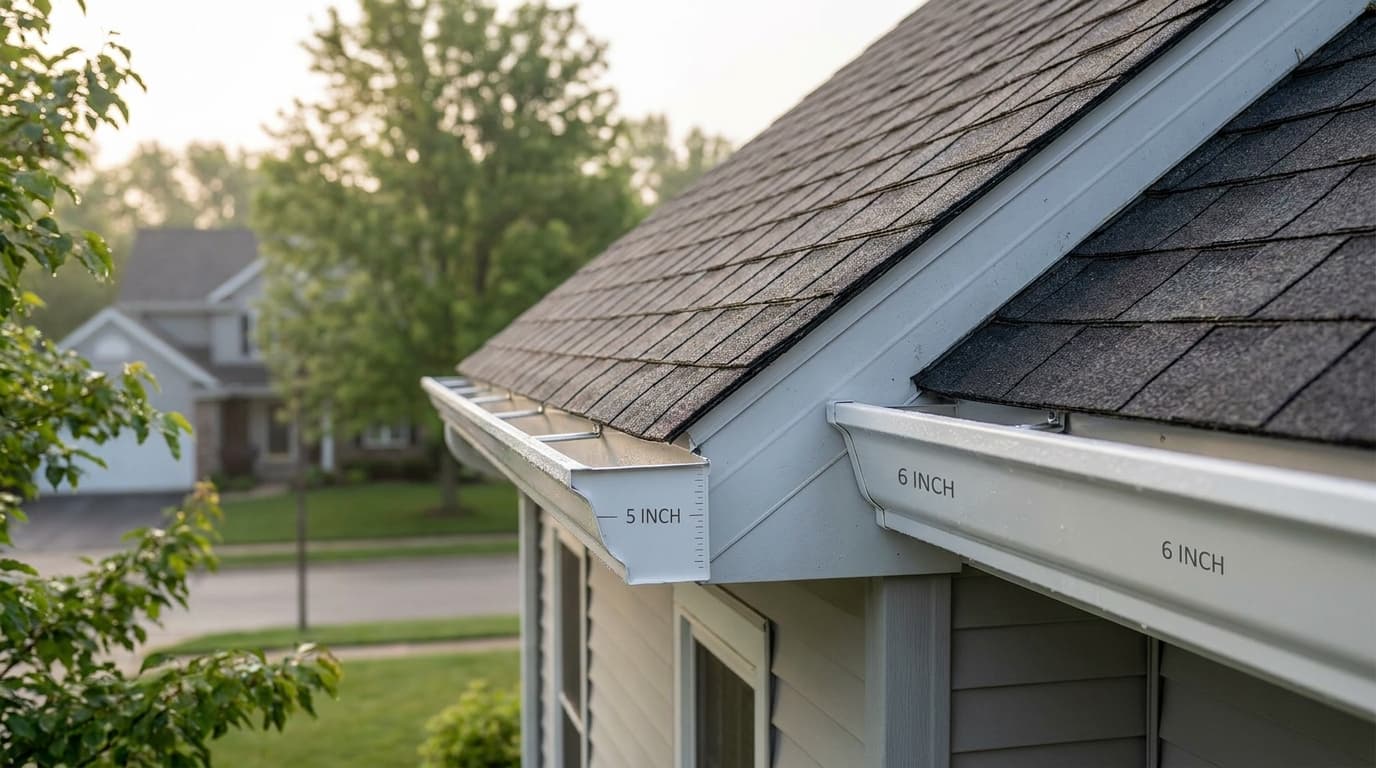
For most Ohio homes, 6-inch seamless gutters are the safer choice — they carry roughly 40% more water than 5-inch gutters and handle the heavy spring and summer downpours that hit Cleveland, Columbus, and Dayton every year. That said, smaller single-story ranches with simple rooflines can still do just fine with a 5-inch profile. The right answer depends on your roof size, pitch, and how much water actually runs off during an Ohio thunderstorm.
If you've lived through a typical summer in Cleveland, Columbus, or Dayton, you've seen what a bad sizing decision looks like. Water pours over the front edge of the gutter like a waterfall, splashes the siding, and pools near the foundation. Nine times out of ten, that's not a clog — that's a capacity problem. Picking the right gutter sizing for your Ohio home is one of the highest-leverage decisions you'll make for the life of your house.
How gutter sizing actually works
A gutter's job is simple: catch everything that rolls off the roof and move it away from the house. The bigger the roof area, the bigger the volume of water. Ohio averages around 39 inches of rain a year, but what really stresses a gutter is the short, intense bursts — the kind of 1-to-2-inch-per-hour downpour that shows up in July.
The two main sizes
- 5-inch K-style: The long-standing residential standard. Works well on roofs under roughly 1,400–1,600 square feet with moderate pitch.
- 6-inch K-style: Carries about 40% more water, uses a 3x4 downspout instead of 2x3, and clogs less often because debris has more room to move.
Why Ohio weather favors the 6-inch
Cleveland gets lake-effect precipitation and heavy freeze-thaw cycles. Columbus and Dayton both see violent spring thunderstorms, and Dayton sits on the edge of Tornado Alley. In all three markets, the peak 10-minute rainfall intensity is what overwhelms gutters — not the annual total. 6-inch gutters give you headroom for those bursts.
When 5-inch gutters are still the right call
Not every home needs to size up. 5-inch gutters are perfectly appropriate when:
- You own a small ranch, cape cod, or bungalow with a simple gable roof.
- Your roof has a moderate-to-steep pitch that sheds water quickly into wider spans of gutter.
- The existing fascia board is only sized for a 5-inch profile and isn't being replaced.
- Aesthetics matter on a historic or smaller-scale home where a 6-inch gutter would look oversized.
When to strongly consider upgrading to 6-inch
In our day-to-day work across Cleveland, Columbus, and Dayton, we recommend 6-inch when any of these apply:
Large roof footprint
Two-story colonials, big suburban builds, and homes with multiple roof planes draining into a single gutter run almost always benefit from 6-inch.
Steep roof pitch
Steep roofs accelerate water. By the time it hits the gutter, it has momentum — a 5-inch trough can actually shoot water right over the edge.
Valleys that dump into one gutter
Roof valleys concentrate water into a narrow stream. If a valley dumps onto a 5-inch run, overflow is almost guaranteed during a hard storm.
You've had overflow problems before
If you've watched water sheet over your existing gutters during a Columbus thunderstorm or a Cleveland lake-effect rain, the gutter is telling you what it needs.
You're adding gutter guards
Most quality gutter guards perform better on 6-inch gutters because the larger opening gives leaves more room to slide off rather than pile up.
What about downspouts?
Sizing the trough is only half the decision. The downspouts have to keep up. 5-inch gutters typically pair with 2x3 downspouts; 6-inch gutters pair with 3x4 downspouts, which move roughly twice the water volume. If you're upgrading to 6-inch gutters, upgrading to 3x4 downspouts is a package deal — otherwise you've just moved the bottleneck.
Regional notes for Cleveland, Columbus, and Dayton
Cleveland
Lake-effect precipitation and steep freeze-thaw cycles mean Cleveland homes carry ice load in the trough more often than homes further south. A 6-inch gutter handles the weight of melting ice and slushy runoff better, and pairs more reliably with heated-cable setups.
Columbus
Columbus homes span everything from Short North bungalows to big New Albany colonials. The broader the roof, the more 6-inch makes sense. For mid-century ranches in places like Worthington or Upper Arlington, 5-inch is often still the right fit.
Dayton
Dayton gets the highest straight-line wind and hail exposure of the three markets. 6-inch gutters with heavier-gauge aluminum tend to hold up better through severe storms, and the bigger trough recovers faster from debris dropped by high winds.
Quick homeowner decision framework
Walk around your house during the next hard rain. If you see water shooting over the front lip, splashing down the siding, or overrunning the back of the gutter into the fascia — your existing size is undersized. If your gutters handle storms cleanly and only back up when they're clogged with leaves, sizing is fine, and you need cleaning or guards instead.
When in doubt, ask your contractor to measure your roof's square footage and pitch, pull your local rainfall intensity factor, and show you the math. Any honest gutter installer can walk you through it in five minutes.
Frequently Asked Questions
What size gutters do most Cleveland homes need?
Most Cleveland homes — especially two-story colonials and homes with lake-effect exposure — do best with 6-inch seamless gutters and 3x4 downspouts. Smaller Cleveland ranches with simple gable roofs can still work well with 5-inch.
Are 6-inch gutters worth the upgrade on a Columbus home?
For most Columbus homes with a larger roof footprint or valleys that concentrate runoff, yes — 6-inch gutters carry about 40% more water and noticeably reduce overflow during central Ohio thunderstorms. On smaller Columbus ranches, 5-inch is usually sufficient.
Do I really need 6-inch gutters in Dayton, Ohio?
In Dayton, where severe spring storms and high winds are common, 6-inch gutters with heavy-gauge aluminum are the safer long-term choice. They recover faster from wind-driven debris and handle hail-season downpours better than 5-inch profiles.
Thinking it through for your own home?
If you're weighing 5-inch vs 6-inch gutters for a home in Cleveland, Columbus, or Dayton, the Zipco Gutters team is happy to walk your roof, measure the drainage load, and tell you honestly which size fits. No pressure — just a neighborly second opinion.
Get a free gutter quote in your city
Serving Cleveland, Columbus, and Dayton with seamless aluminum gutters, written quotes, and a workmanship warranty.