
Gutter Maintenance for Columbus Rental Properties: A Landlord's Guide
Deferred gutter maintenance is one of the costliest mistakes in a rental portfolio. A practical maintenance approach for Columbus landlords and property managers.
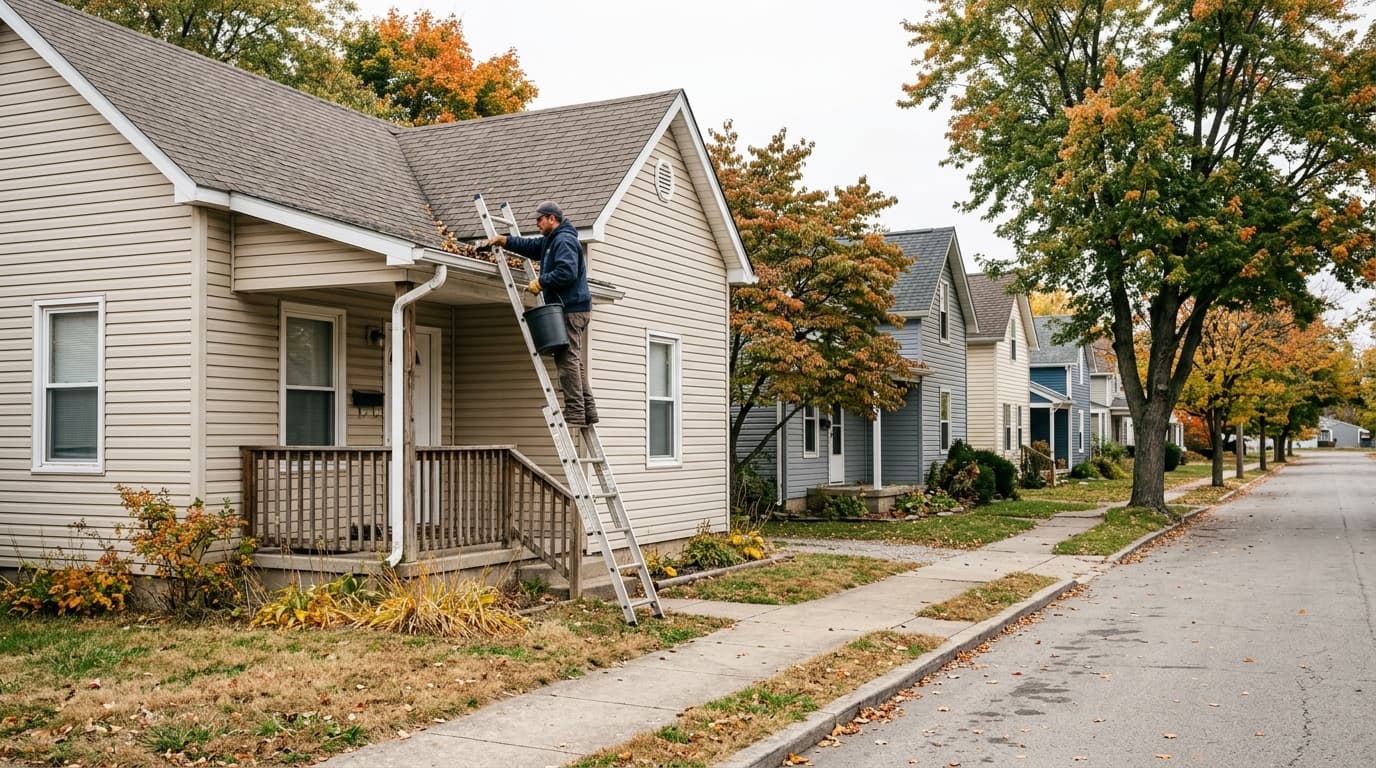
For a rental property, gutters are pure downside risk: nobody notices when they work, and when they fail the bill arrives as water damage, tenant complaints, and a vacancy. A twice-a-year cleaning across a portfolio costs less than one wet basement, and it's the maintenance line item with the clearest return in central Ohio.
Columbus has one of the more active rental markets in the Midwest — the campus-area housing around Ohio State, the rehabbed stock in Franklinton, Olde Towne East, and the Hilltop, single-family rentals throughout Reynoldsburg, Gahanna, Grove City, and Whitehall, and a steady flow of build-to-rent product in the outer suburbs. Whether you own two doors or two hundred, the gutter math works the same way.
Why rentals fail at this specifically
Owner-occupants notice things. They see the overflow during a storm because they're standing at the window. They notice the streak on the siding because they park under it every day.
Rentals lose all of that:
- Tenants don't report what they don't recognize as a problem. Water sheeting off a gutter during a downpour reads as "it's raining hard," not "call the landlord."
- Nobody's watching the exterior. By the time a tenant reports something, it's usually interior — a stain on a ceiling, a damp corner in the basement — which means the exterior problem has been running for months or years.
- Turnovers focus on the inside. Paint, carpet, appliances. The gutter line rarely gets a look.
- Deferred maintenance compounds. A leaking seam rots fascia, rotted fascia drops the gutter, a dropped gutter dumps water at the foundation, and now you have a basement problem instead of a $20 tube of sealant problem.
What it actually costs when it goes wrong
The failure chain in central Ohio is predictable:
- Clogged or undersized gutters overflow and water lands in a concentrated line at the foundation.
- Central Ohio's clay soil doesn't absorb it, so it travels down the loose backfill ring beside the foundation wall.
- Water enters the basement or crawlspace — seepage, a running sump, damp block walls.
- Now you have a habitability conversation with a tenant, plus moisture, odor, and potentially mold remediation.
- Meanwhile the fascia and soffit are rotting from the original leak, and squirrels and birds have found the gap.
Any single one of those repairs typically exceeds several years of routine cleaning across the property. And unlike most maintenance, it isn't a matter of if — a neglected gutter in Ohio's freeze-thaw climate will fail on a knowable schedule.
A maintenance approach that scales
Put it on a schedule, not a request queue
The single most effective change is to stop treating gutter cleaning as reactive. Schedule it:
- Twice a year minimum — spring after the seed and catkin drop, and late fall after the leaves are down.
- Three times on properties with heavy tree cover, which describes much of Clintonville, Bexley, the Hilltop, and older Grove City and Reynoldsburg streets.
- Book the portfolio together. A contractor doing eight of your properties in a route prices differently than one doing a single house across town, and you stop paying for eight separate trip charges.
Combine it with an exterior inspection
While someone is already on a ladder at the roof edge, they can see almost everything that matters about the building envelope: fascia condition, soffit gaps, drip edge, shingle edges, downspout connections, and where water is discharging. Ask for that as part of the service and you get an annual envelope report for effectively free.
Fix the root causes once
Recurring service calls on the same property usually mean something structural is unaddressed:
- Add downspouts where long runs drain to a single outlet. It's cheap and it eliminates a recurring overflow complaint.
- Extend discharge six feet or more, and on rentals, use extensions that won't be removed by a mower and left in the grass. Buried lines to daylight are worth it on properties with chronic basement issues.
- Upgrade to 6-inch with 3x4 downspouts on homes that overflow when clean.
- Install leaf protection on the heavy-canopy properties. Run the numbers per property: on a house needing three cleanings a year, guards can pay for themselves over a reasonable holding period, and they eliminate the emergency calls.
- Repair fascia properly rather than re-hanging a gutter on compromised wood. It will fail again, and you'll pay the mobilization twice.
Document it
Keep dated records of service, and photos where possible. Maintenance documentation matters for insurance claims — policies generally cover sudden damage and exclude damage attributed to neglect — and it matters if a habitability dispute ever arises. A clean maintenance log is a genuinely useful asset.
Multi-unit and older buildings
If you own doubles, fourplexes, or older converted buildings — common in Columbus's near-east and near-west neighborhoods — a few extra considerations:
- Shared roof drainage means one clogged run affects multiple units.
- Older buildings may have buried downspout lines to the sewer, some of them failing. A downspout that backs up at the top is the tell.
- Historic district rules apply in some Columbus neighborhoods and cover exterior changes visible from the street. Check before replacing.
- Access and parking are constrained on tight urban lots, which affects scheduling and cost.
Frequently Asked Questions
How often should rental property gutters be cleaned in Columbus?
Twice a year is the baseline — once in spring after the seeds and catkins drop, once in late fall after leaf drop finishes. Properties with heavy mature tree cover, common in Clintonville, Bexley, and older Grove City and Reynoldsburg streets, generally need a third pass. Scheduling it proactively costs far less than responding to the water damage that follows a missed year.
Are gutter guards worth it on a Columbus rental property?
Often, yes — particularly on properties with heavy tree cover that need three cleanings a year. The calculation is straightforward: compare the guard cost against your cleaning spend plus the emergency calls over your expected holding period. Guards also reduce the failures you never find out about, which is the real risk on a rental.
Who is responsible for gutter cleaning, the landlord or the tenant?
In practice this is the property owner's responsibility, and it should be. It's roof-height ladder work with real injury risk, it requires knowing what you're looking at, and the consequence of it being done badly or not at all lands on the building. Check your lease language, but assigning it to a tenant is a liability you don't want.
Portfolio pricing, one contractor
The Zipco Gutters of Columbus team works with landlords and property managers across central Ohio on scheduled cleaning, repairs, and leaf protection — routed together across multiple addresses, with documentation you can file. Reach out to talk through your properties and get an estimate.
Get a free gutter quote in your city
Serving Cleveland, Columbus, and Dayton with seamless aluminum gutters, written quotes, and a workmanship warranty.