
Half-Round vs. K-Style Gutters: Which Is Right for Your Ohio Home?
Half-round or K-style gutters for your Ohio home? Compare capacity, cost, looks, and upkeep for Cleveland, Columbus & Dayton homeowners choosing a profile.
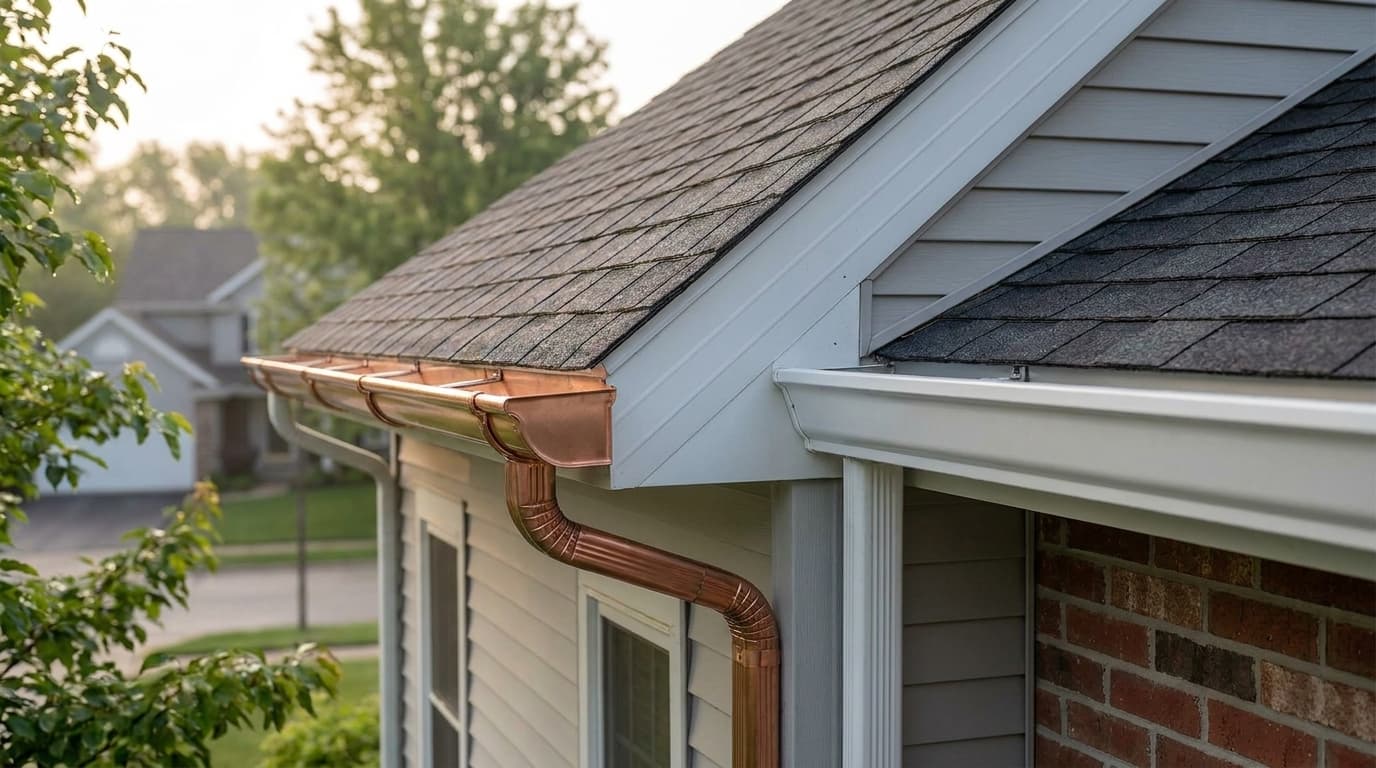
For most Ohio homes, K-style gutters are the practical choice — they carry more water, cost less, and are far more common, while half-round gutters are a period-appropriate upgrade best suited to historic and high-end homes. K-style's flat back and decorative front give it more capacity per inch and let it mount flush to the fascia, while half-round's smooth semicircular trough is prized for its classic look and easy-flushing shape. The right profile depends on your home's age, architecture, and how much rainfall your roof sheds.
If you've never thought about the shape of your gutters, you're not alone — most homeowners don't until it's time to replace them. But the profile matters more than it seems. It affects how much water your gutters can carry, how they look against your home's lines, how easily they clog, and what they cost. Across Cleveland, Columbus, and Dayton, two profiles dominate the conversation: K-style and half-round. Here's how they stack up for an Ohio home.
What the two profiles actually are
K-style
K-style gutters have a flat bottom and back, with a front side shaped in a decorative ogee curve that, in profile, roughly resembles the letter K. That flat back mounts directly against the fascia board, and the shape is designed to look a bit like crown molding from the ground. K-style has been the residential standard across the United States — and Ohio — for decades.
Half-round
Half-round gutters are exactly what they sound like: a smooth, semicircular trough, like a tube cut lengthwise. They hang from brackets rather than mounting flat to the fascia, and their rounded shape gives them a softer, more traditional profile. You'll see them most often on older homes, historic districts, and architect-designed builds.
Capacity: how much water each carries
This is where K-style has a clear edge. Because of its flat-bottomed, boxier shape, a K-style gutter holds more water than a half-round of the same nominal width.
- A 5-inch K-style gutter carries meaningfully more water than a 5-inch half-round, simply because the boxy cross-section has more area.
- For Ohio's short, intense summer downpours — the 1-to-2-inch-per-hour bursts that show up in July across Columbus and Dayton — that extra capacity is genuinely useful.
- If you choose half-round and have a large or steep roof, sizing up to 6-inch is often the way to make up the difference.
For homes that regularly see heavy runoff, K-style's capacity advantage is one of the strongest arguments in its favor.
Clogging and maintenance
The two profiles handle debris differently:
- Half-round has a smooth, curved interior with no flat corners for debris to catch on, so it tends to flush more freely and is a little easier to clean by hand.
- K-style has interior corners where the flat bottom meets the sides, which can trap grit and leaf matter — though in practice, both profiles need regular cleaning under Ohio's tree cover, and gutter guards largely neutralize the difference.
If you're set on a low-maintenance system, guards matter more than profile.
Cost and availability
K-style wins clearly on both:
- K-style is less expensive to manufacture, form, and install, and nearly every gutter contractor in Ohio installs it as standard.
- Half-round costs more — often significantly — because of the specialized forming, the hanging brackets, and the fact that it's frequently paired with premium materials like copper.
- Availability favors K-style; half-round is a specialty product that not every installer offers, so you may have fewer contractors to choose from.
Looks and architectural fit
This is where half-round earns its place. Profile is largely an aesthetic decision once capacity is handled.
- Half-round suits historic homes, Tudors, Victorians, Colonials, and any house with traditional or period detailing. On the right home, it looks authentic in a way K-style can't replicate — which is why historic districts sometimes require it.
- K-style looks clean and at home on the vast majority of modern and mid-century houses. Its crown-molding-like profile reads as tidy and contemporary on typical suburban builds.
Match the gutter to the architecture: a half-round on a 1990s ranch can look out of place, and boxy K-style on a restored Victorian can undercut the home's character.
Quick guide for Ohio homeowners
- Choose K-style if you want more capacity, lower cost, wide contractor availability, and a look that fits most modern and suburban Ohio homes.
- Choose half-round if you own a historic or architecturally traditional home, want a classic profile, and are willing to pay more — often paired with copper — for the right look.
Regional notes for Cleveland, Columbus, and Dayton
Cleveland
Cleveland's older neighborhoods — Ohio City, Tremont, Shaker Heights — have plenty of historic homes where half-round is architecturally appropriate and occasionally expected. That said, Cleveland's heavy snow and ice load make capacity and clean drainage important, so if you go half-round on a larger home, sizing up to 6-inch is a smart move.
Columbus
Columbus offers a clear split: historic districts like German Village and Victorian Village are natural homes for half-round, while the sprawling suburban builds around New Albany, Dublin, and Westerville are firmly K-style territory. For most central Ohio homeowners, K-style's capacity handles the region's heavy summer thunderstorms with room to spare.
Dayton
Dayton's high storm and rainfall intensity makes water capacity a real priority. K-style is the practical default for most Dayton homes because it carries more water per inch, which matters when severe storms dump rain fast. Half-round remains a fine choice for Dayton's historic homes, ideally in a 6-inch size to keep up with the downpours.
Frequently Asked Questions
Are half-round gutters a good fit for a historic Cleveland home?
Half-round gutters are often an excellent fit for a historic Cleveland home — they suit period architecture and are sometimes expected in historic districts. Just keep capacity in mind: given Cleveland's heavy snow and ice, sizing up to 6-inch half-round is wise on larger or steeper roofs.
Do K-style gutters carry more water than half-round in Columbus?
Yes. For the same nominal width, K-style gutters carry more water than half-round because of their boxier cross-section. For Columbus homes facing heavy central Ohio thunderstorms, that extra capacity is a meaningful advantage, which is why K-style is the practical standard for most suburban builds.
Which gutter profile is best for storm-prone Dayton homes?
For most storm-prone Dayton homes, K-style is the best profile because it carries more water per inch and handles fast, heavy rainfall better. Half-round works well on Dayton's historic homes, but it's best sized up to 6-inch to keep pace with the region's intense downpours.
Let's match the profile to your home
Whether your home calls for practical K-style or a classic half-round profile, the Zipco Gutters team is happy to walk your property in Cleveland, Columbus, or Dayton and talk through capacity, cost, and curb appeal. We'll help you choose the profile that fits your home and your budget — honestly.
Get a free gutter quote in your city
Serving Cleveland, Columbus, and Dayton with seamless aluminum gutters, written quotes, and a workmanship warranty.