
Snowbelt Ready: Preparing Cleveland Gutters for Lake-Effect Winter
Lake-effect snow and freeze-thaw punish Cleveland gutters. A pre-winter prep guide for Northeast Ohio homeowners — what to fix in November, and why.
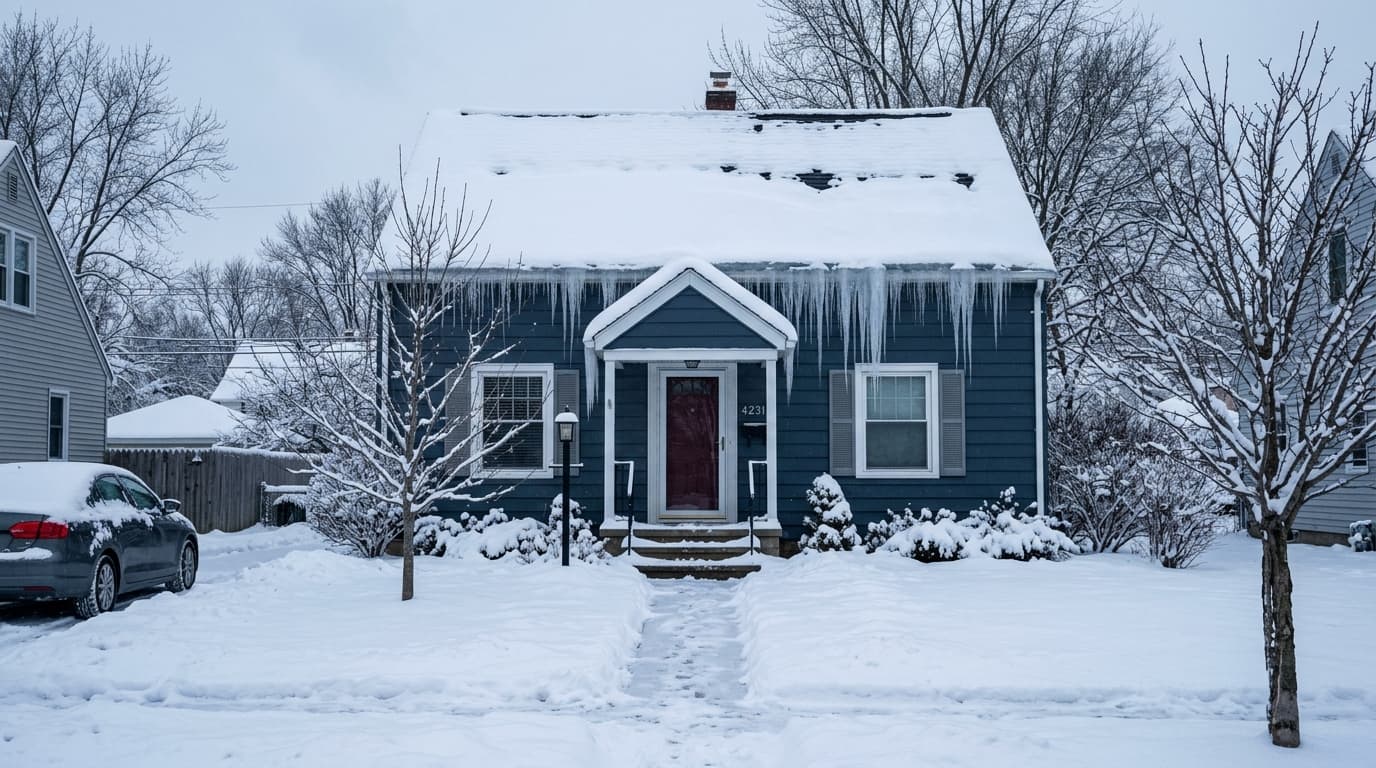
Getting Cleveland gutters through a lake-effect winter comes down to four things done before the first hard freeze: clear the troughs and downspouts completely, confirm every hanger is tight and the pitch is true, make sure water discharges well away from the foundation, and fix any spot where water can get behind the gutter. A clean, well-supported gutter handles a Northeast Ohio winter. A clogged, sagging one becomes an ice dam anchor.
Cleveland's winters are hard on gutters in two distinct ways, and homeowners tend to only think about one of them. There's the snow load — heavy, wet lake-effect accumulation that adds real weight to the roof edge. And there's the freeze-thaw cycle, which is arguably the more destructive of the two, because our winters swing back and forth across 32°F over and over rather than staying frozen.
The two forces working on your gutters
Lake-effect snow and ice load
Northeast Ohio's snowfall is famously uneven. The heaviest lake-effect bands set up east and southeast of the city — Geauga County, Chardon, Chesterland — where annual totals run far above what the west and southwest suburbs see. But Strongsville, North Royalton, Parma, Medina, and Brunswick still get plenty, and lake-effect snow is wet and dense. When that snow melts at the warm roof surface, refreezes at the cold overhang, and builds into a ridge of ice, a gutter full of frozen debris gives it something to grab.
Water and ice are heavy. A trough packed with wet leaves and then frozen solid can carry far more weight than the hangers were designed for — which is how gutters end up hanging off the fascia by March.
Freeze-thaw cycling
Cleveland gets a lot of trips across the freezing point. Every cycle expands and contracts the aluminum, works at the sealant in the seams, and slowly backs fasteners out of the fascia. Water that seeps into a hairline gap freezes, expands, and makes the gap bigger. Do that a few dozen times a winter and a minor seam leak becomes a real one.
This is the quiet reason Northeast Ohio gutters age faster than the same gutters would in a milder climate — and the reason seamless runs with hidden hangers hold up so much better here than old sectional gutters with spikes.
The pre-winter checklist
Do this in November, before the trough can freeze.
- Clean everything out — completely. Not most of it. Any debris left in the trough is a seed for an ice blockage. Include the downspouts; a packed elbow freezes solid and splits the seam.
- Flow-test with a hose. Water should move steadily to each downspout and out the bottom. Pooling means lost pitch.
- Tighten and add hangers. Hidden hangers roughly every two feet, screwed into solid fascia. If your gutters still hang on spikes, expect them to loosen under ice load. Any run that already sags will sag more when it's full of ice.
- Reseal open seams on dry aluminum, and note which ones you've sealed before. Repeat resealing is a sign the gutters are at the end of their life.
- Check the fascia and soffit. Soft or stained wood means water has already been getting behind the gutter. That gets dramatically worse in winter.
- Confirm the drip edge directs roof runoff into the gutter rather than behind it.
- Extend discharge away from the house. Four to six feet minimum. Northeast Ohio's winter thaws send a lot of meltwater down at once, and frozen ground can't absorb it — it runs along the surface straight to whatever low point it finds, often your foundation wall.
- Retract or plan for extensions in snow. Extensions that get removed for snow plowing or shoveling and never put back are a very common cause of spring basement water.
Ice dams: what gutters can and can't do
There's a persistent myth that gutters cause ice dams. They don't. Ice dams form when heat escaping through the roof melts snow on the upper roof, the meltwater runs down to the cold eave, and it refreezes there. The root cause is attic insulation and ventilation, not gutters.
What gutters do is make it worse or better at the margins. A clean, free-flowing gutter lets meltwater actually leave. A gutter full of frozen debris gives the ice a foothold right at the roof edge and holds the dam in place longer. And once a dam has formed, water backing up under the shingles is what damages the roof deck, insulation, and ceiling below.
So: fix the attic if you have chronic ice dams. Clean the gutters either way, because the alternative makes the same problem worse.
Gutter guards in a Cleveland winter
Guards help in winter for one main reason: a gutter that stays empty can't freeze full of debris. Perforated aluminum panels are the type we prefer for Northeast Ohio because debris on top dries out and blows off rather than matting, and there's no fine screen to blind over.
Two honest caveats. First, no guard prevents ice dams — that's an attic problem, and any company claiming otherwise is overselling. Second, guards don't stop ice from forming in the trough during heavy freeze-thaw; they just keep it from having leaves to bond to.
Frequently Asked Questions
When should Cleveland homeowners do winter gutter prep?
November, before the first sustained hard freeze. Once debris in the trough freezes into a solid mass, it can't be cleared safely, and you've lost the window. Aim for mid-to-late November, after the oaks have finished dropping but ahead of Northeast Ohio's first real cold snap.
Do gutters cause ice dams in Northeast Ohio?
No. Ice dams are caused by heat escaping through the roof, melting snow that then refreezes at the cold eave — an insulation and ventilation issue. But clogged, frozen gutters absolutely make a dam worse by giving the ice something to anchor to and blocking meltwater that would otherwise drain away.
Will gutter guards prevent ice dams on a Cleveland home?
No guard prevents ice dams, and you should be skeptical of any company that says otherwise. What quality guards do is keep the trough clear of debris so it can't freeze into a solid, ice-anchoring mass — a real benefit in a Cleveland winter, just not the one that's often advertised.
Get ready before the first freeze
The Zipco Gutters team handles pre-winter cleaning, repairs, re-hanging, and leaf protection across Cleveland and the surrounding suburbs — Strongsville, North Royalton, Brecksville, Parma, Medina, Westlake, and beyond. Reach out for a free estimate and go into the snowbelt season with a system that's ready for it.
Get a free gutter quote in your city
Serving Cleveland, Columbus, and Dayton with seamless aluminum gutters, written quotes, and a workmanship warranty.