
Gutters for Columbus Historic Homes: German Village, Clintonville, Bexley & Worthington
Historic Columbus homes need gutters that fit the architecture and the review board. A guide to half-round, copper, and period-appropriate choices in central Ohio.
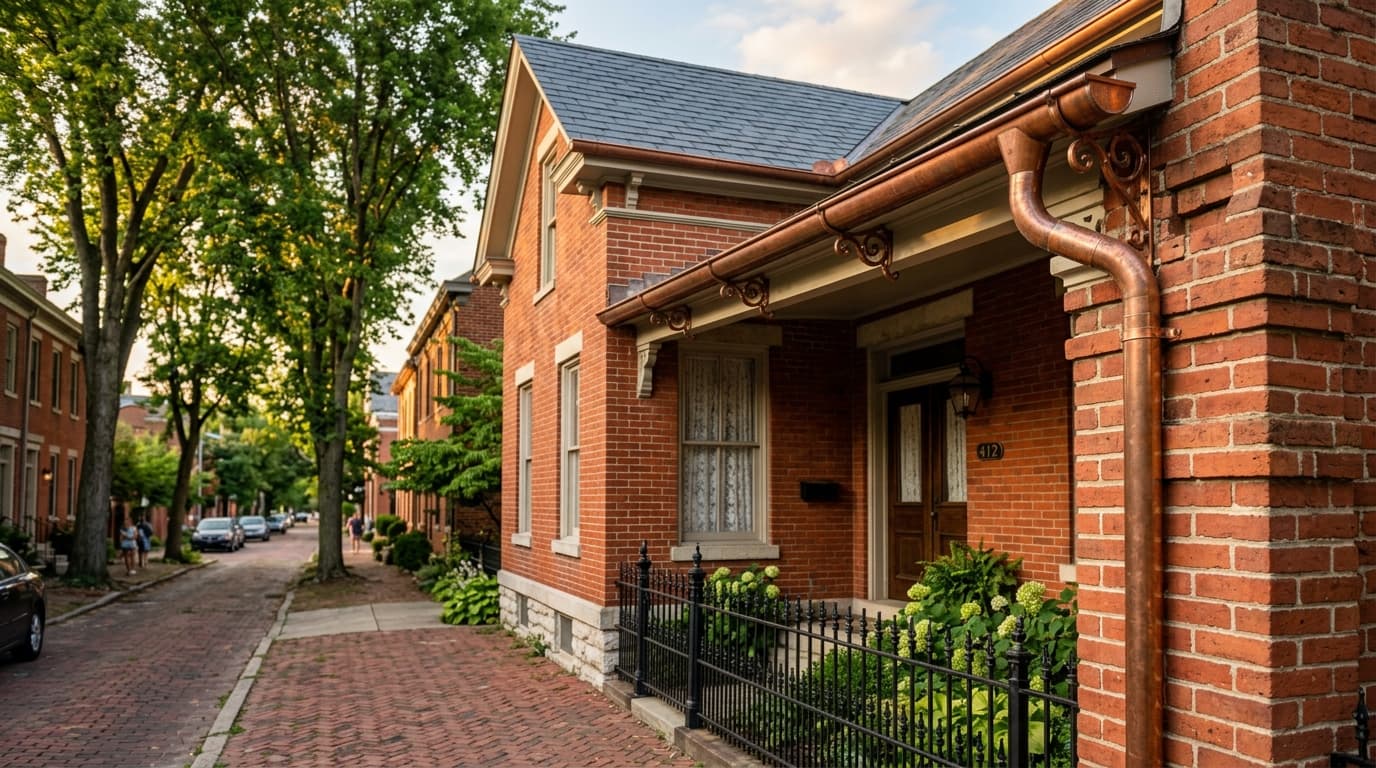
On a historic Columbus home, the gutter decision has three parts: a profile that suits the architecture — usually half-round rather than K-style — a material and finish that reads correctly from the street, and, in a designated historic district, a design that will clear architectural review before anyone starts working. Get those three right and the gutters disappear into the house. Get them wrong and they're the first thing a preservation-minded neighbor notices.
Columbus has an unusually deep stock of historic housing for a growing city. German Village's 19th-century brick, the Victorian Village and Italian Village stock north of downtown, Old Oaks and Olde Towne East, the century homes lining Clintonville, the stately older streets of Bexley and Upper Arlington, and Worthington's Old Village core. Each has its own architectural logic, and modern builder-default gutters often fight it.
Why K-style looks wrong on an older home
K-style is the modern default across central Ohio for good reasons: it holds more water per inch of width, it's inexpensive to form on-site, and the flat back mounts easily. Its front profile is loosely modeled on crown molding.
On a mid-century or contemporary home, it's invisible. On a 19th-century brick rowhouse or a 1910s foursquare, the ogee profile can read as busy and out of period — especially at close range on a narrow street where the gutter line is at eye level from the sidewalk.
Half-round: the period-correct profile
Half-round gutters are exactly what they sound like — a smooth semicircular trough, typically hung on decorative brackets or straps and paired with round rather than rectangular downspouts. It's the profile that existed when these homes were built, and on a Victorian, Queen Anne, Colonial Revival, Tudor, or 19th-century brick home it simply looks right.
The practical trade-offs are honest ones:
- Capacity is lower at the same nominal width, because a half-round holds less water than a K-style of the same size. On a big roof, that often means going up a size — 6-inch half-round rather than 5.
- It costs more to form, hang, and detail than K-style.
- It sheds debris better. The smooth curve has no flat bottom corners for sludge to pack into, which is a real maintenance advantage on Clintonville and Bexley's heavily canopied streets.
Material choices that read correctly
Aluminum
Seamless aluminum in a well-chosen color is the practical choice for most historic Columbus homes, and it's available in half-round. It's affordable, it won't rust, and a dark bronze or black finish on a brick home reads far better than bright white. Heavier .032 gauge is worth it here — historic homes often have complex rooflines and long runs.
Copper
Copper is the premium period-correct option, and on a significant home in German Village or Bexley it can be the right call. It weathers from bright penny to brown to eventually the green patina, it lasts for generations, and it's soldered rather than sealed at the joints. It also costs multiples of aluminum, and it's a target for theft on unoccupied properties. Worth it on the right house; overkill on most.
Galvanized and steel
Historically common and still used in restorations, but it will eventually rust in central Ohio's climate and needs maintenance that most homeowners don't want to sign up for.
The review board question
This is the part homeowners most often discover too late. Columbus's designated historic districts — German Village, Victorian Village, Italian Village, and others — have review commissions that evaluate exterior changes for appropriateness. Worthington's Architectural Review Board covers its Old Village district. Several other central Ohio communities have their own equivalents.
A few practical realities:
- Rules vary by district, and by whether the change is visible from the street. Assume nothing based on what a neighbor did.
- In-kind replacement is generally the easiest path. Replacing existing half-round copper with half-round copper is a very different conversation than switching a historic home to white K-style vinyl.
- Color and profile are what get scrutinized, more than the underlying material in many cases.
- Ask before you order. Custom-formed half-round in a specific color is not something you want sitting in a driveway while an application gets sorted out.
A contractor who works in these neighborhoods should be able to tell you what's typically approved and what typically isn't — but the application is between you and the commission, and the honest answer to "will this be approved?" is always "check with them first."
The condition problem behind the gutter
On a home that's 80 to 140 years old, the gutter is often the easy part. What's behind it usually isn't.
- Original wood fascia may be soft, painted over many times, or partially rotted from decades of a leaking gutter. Hidden hangers need solid wood to bite into.
- Many older Columbus homes have no drip edge, so water runs behind the gutter by default.
- Rafter tails and built-in box gutters show up on some period homes. Built-in gutters — troughs integrated into the roof structure itself — are a specialty repair, not a swap-out, and any contractor who proposes simply hanging new gutters over one hasn't understood the roof.
- Masonry attachment on brick rowhouses is its own problem where there's no fascia board to hang from.
Budget for fascia and soffit work on a historic home. On these houses it's the rule, not the exception, and doing it right is what keeps the next set of gutters from failing early.
Frequently Asked Questions
Do I need approval to replace gutters on a German Village home?
Very likely, yes. German Village is a designated historic district with a review commission that evaluates exterior changes, and gutters visible from the street generally fall under that. In-kind replacement — same profile, same material, same color — is usually the smoothest path, but confirm with the commission before ordering custom material.
Are half-round gutters worth it on a historic Columbus home?
On a Victorian, Queen Anne, Colonial Revival, or 19th-century brick home, half-round is the period-correct profile and it makes a visible difference from the street. It also sheds debris better than K-style, which matters on Clintonville and Bexley's canopied lots. The trade-offs are lower capacity at the same width and a higher price — often solved by going up one size.
What gutter material is best for an older home in Bexley or Clintonville?
For most homeowners, seamless .032 aluminum in a dark, period-appropriate color offers the best balance of appearance, durability, and cost, and it's available in half-round. Copper is the premium choice on a significant home — beautiful and effectively permanent, but several times the price and worth reserving for houses that justify it.
Talk to someone who works on these houses
If you own an older home in German Village, Clintonville, Bexley, Worthington, Upper Arlington, or anywhere else in central Ohio, the Zipco Gutters of Columbus team can walk the house with you, assess the fascia behind the gutter, and lay out options that fit both the architecture and the budget. Reach out for a free estimate.
Get a free gutter quote in your city
Serving Cleveland, Columbus, and Dayton with seamless aluminum gutters, written quotes, and a workmanship warranty.