
Gutter Advice for Dayton's Mid-Century Ranches: Kettering, Centerville & Huber Heights
Postwar ranch homes have their own gutter problems — long runs, wide overhangs, low-slope roofs. What Kettering, Centerville & Huber Heights homeowners should know.
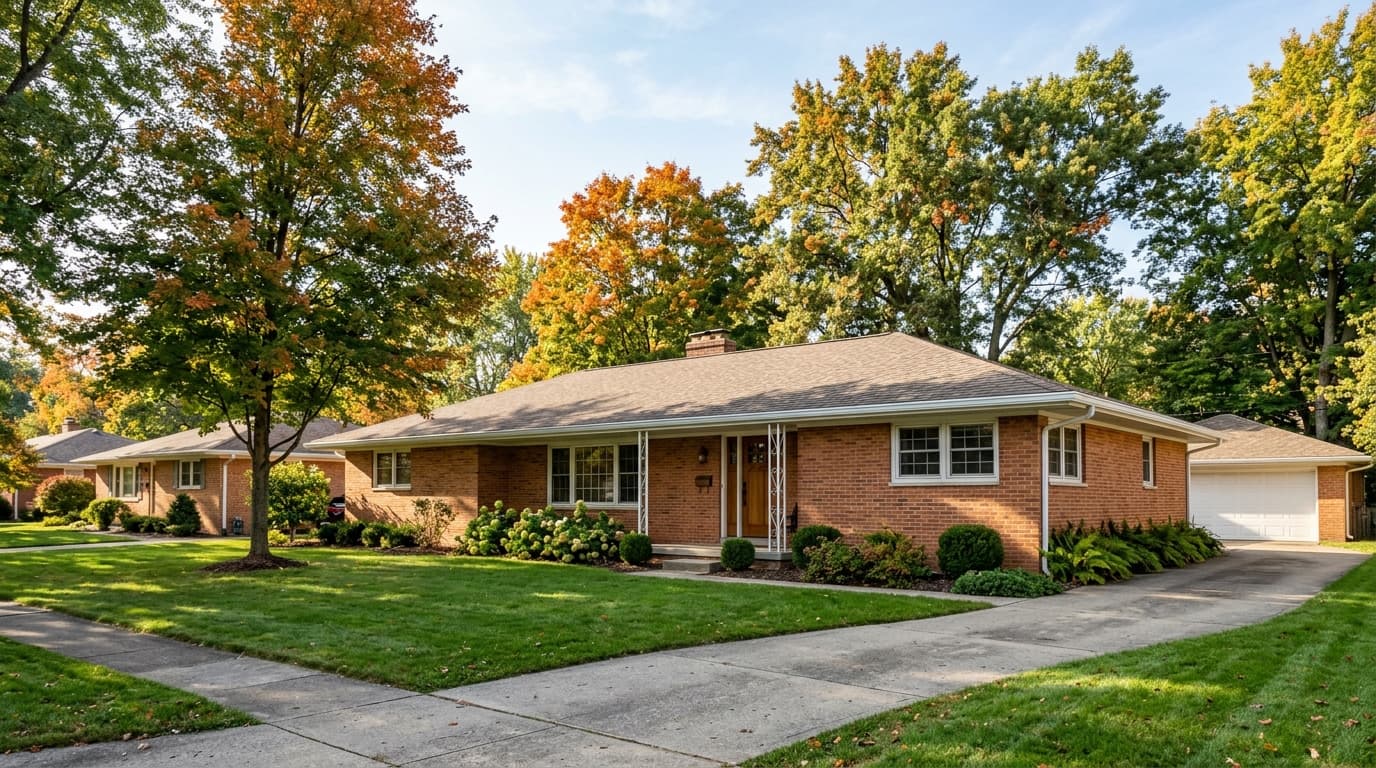
A postwar ranch is not a small version of a two-story house, and its gutters shouldn't be treated like one. The defining issues are long uninterrupted runs that lose pitch, low-slope roofs that dump water slowly but relentlessly, wide overhangs that push runoff away from the wall, and 60-year-old fascia that may not hold a hanger anymore. Fix the pitch and the downspout count, and most ranch gutter complaints go away.
The Dayton area is full of these houses. The postwar boom filled Kettering, Centerville, Huber Heights, Vandalia, Riverside, and West Carrollton with single-story brick and frame ranches, many built between the late 1940s and the mid-1960s. They're well-built, well-proportioned homes — and they present a specific set of gutter problems that a contractor used to newer two-story construction will miss.
The long run problem
The signature feature of a ranch is a long, low, horizontal roofline. That often means a single gutter run of 50, 60, or 70 feet across the front or back with nothing interrupting it.
Why length causes trouble
Gutters need pitch — roughly a quarter inch of fall for every 10 feet — to move water toward the downspout. Over a 60-foot run pitched to one end, that's an inch and a half of drop, which is visible and can look off against a perfectly level roofline. So installers frequently split the difference: too little pitch to drain well, but enough to still look slightly crooked.
Long runs also sag. More span means more unsupported aluminum, and every sag becomes a low spot that holds standing water, breeds mosquitoes, and adds weight that pulls the hanger further out.
The fix
The right answer on most ranches is to split the run and pitch it in two directions, with a high point in the middle and downspouts at both ends. Each half only needs half the drop, so the pitch is both effective and visually subtle. Add hidden hangers roughly every two feet — closer on the longest spans — and the sag problem largely resolves itself.
Low-slope roofs behave differently
Many mid-century ranches have shallow roof pitches. A low-slope roof sheds water more slowly than a steep one, which sounds like an advantage but isn't entirely.
- Water runs slower but lingers longer, so debris tends to stay on the roof and wash into the gutter gradually rather than all at once.
- Wind-driven rain can push water sideways across a shallow roof and past the gutter entirely, or drive it back under the shingle edge if the drip edge isn't right.
- Snow sits. A low-slope roof holds snow rather than shedding it, and that load melts and refreezes at the eave through Dayton's freeze-thaw winters.
For most ranches, 5-inch K-style is genuinely adequate — the roof area draining into any given run is modest and the water arrives at a manageable rate. The exception is a ranch with a large single roof plane or an added-on wing dumping into a short section, where 6-inch is the safer spec.
Wide overhangs cut both ways
Deep eaves are a mid-century hallmark, and they're actually good for your house — they shade windows and keep runoff away from the walls. But they change the gutter equation:
- The gutter sits farther from the foundation, so a downspout that discharges straight down at the base of the wall lands in a spot that would otherwise stay relatively dry. Extensions still matter, but the starting point is better than on a modern home with minimal overhang.
- Access is harder. A ladder has to be set farther out, at a shallower angle, to reach a deep eave — one reason ranch gutter cleaning isn't always the easy ground-level job people assume.
- Soffits are wide and often original. Mid-century soffit panels are frequently the original wood or early aluminum, and a wide soffit that's been getting wet from a leaking gutter hides that damage well.
The fascia is 60 years old
This is the thing that surprises people most. Your gutters may be 15 years old; the board they hang on is likely original to the house.
On homes of this era, look for:
- Soft or spongy fascia where a gutter has leaked at a seam for years. Hidden hangers need solid wood — screwing new hangers into rotted fascia is a repair that fails within a season or two.
- Layers of paint hiding cracks and separations.
- No drip edge. Roofs built before drip edge became standard practice often let water run behind the gutter, which is exactly what rots the fascia in the first place.
- Old spike-and-ferrule hangers. Common on homes of this vintage, and they work loose over decades of expansion and contraction. Every re-driven spike enlarges the hole a little more.
The honest recommendation on a mid-century Dayton ranch is to plan for fascia work as part of the project, or at least to have it evaluated before the quote is final. Aluminum fascia wrap over sound wood is a durable long-term answer; wrapping over rot just hides it.
The good news about ranches
It's not all problems. Compared to a two-story home:
- Cleaning and maintenance cost less, because the work is lower and safer.
- Repairs are more accessible, so small problems can be caught and fixed cheaply.
- Gutter guards are easy to service if something does need attention.
- Total linear footage is often lower than an equivalent-square-foot two-story, since the roofline is simpler.
A ranch that's been given proper pitch, adequate downspouts, and solid fascia is one of the easiest houses in the Dayton area to keep in good shape.
Frequently Asked Questions
Why do the gutters on my Kettering ranch sag in the middle?
Long unbroken runs are the usual cause. A 50- to 70-foot span with hangers spaced too far apart will develop a belly, and once it does, standing water in that low spot adds weight and makes it worse. The fix is hidden hangers roughly every two feet plus, on the longest runs, splitting the run to pitch toward downspouts at both ends.
Do mid-century ranch homes need 6-inch gutters?
Usually not. The roof area draining into any single run on a typical ranch is modest, and 5-inch K-style handles it. Six-inch makes sense when a large single roof plane or an addition dumps into a short section, or on a heavily wooded lot where the extra width reduces clogging.
Should I replace the fascia when I replace gutters on an older Dayton home?
Have it evaluated, and expect that some of it will need attention. On a house built in the 1950s or 60s the fascia is likely original, and decades of a leaking gutter seam or a missing drip edge leaves soft spots. New hangers need solid wood to hold, so fixing or wrapping compromised fascia is what makes the new gutters last.
Get your ranch looked at properly
If you own a mid-century home in Kettering, Centerville, Huber Heights, Vandalia, Riverside, or anywhere in the Miami Valley, the Zipco Gutters of Dayton team will check the pitch, the hangers, and the fascia behind the gutter — not just quote linear feet. Reach out for a free estimate.
Get a free gutter quote in your city
Serving Cleveland, Columbus, and Dayton with seamless aluminum gutters, written quotes, and a workmanship warranty.