
Clogged Gutters and Basement Flooding: The Overlooked Ohio Connection
The overlooked link between clogged gutters and basement flooding in Ohio. A Cleveland, Columbus & Dayton guide to how a full trough soaks your basement.
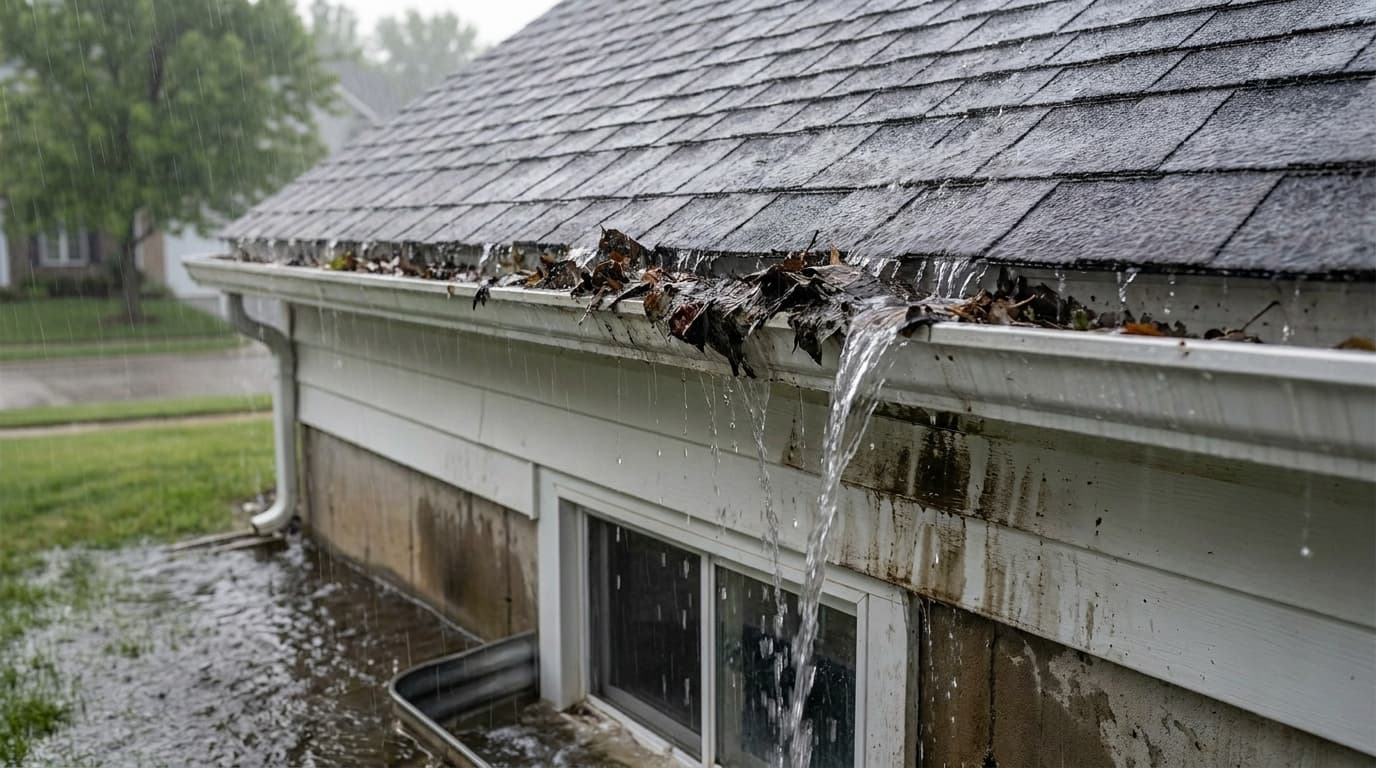
Clogged gutters are one of the most common causes of basement flooding in Ohio, and almost nobody suspects them. When a gutter overflows, it dumps hundreds of gallons of concentrated roof water straight down against the foundation — exactly where it can seep through cracks, pour into window wells, and overwhelm the soil around your basement walls. In Cleveland, Columbus, and Dayton, a five-dollar clog upstairs is often the real reason there's water downstairs.
Homeowners dealing with a wet basement usually look everywhere but up. They inspect the sump pump, seal the cracks, run a dehumidifier, maybe even call a waterproofing company — all while the actual source is a leaf-packed gutter forty feet overhead. It's the most overlooked connection in home maintenance because the cause and the symptom are on opposite ends of the house.
Ohio's climate makes the link even stronger. The state's heavy spring and summer rains test every gutter to its limit, and the region's clay soils and high water tables leave basements with little margin for error. When a clogged gutter adds a torrent of misdirected water to already saturated ground, the basement is where it all ends up.
How a clog upstairs becomes water downstairs
The path from a leaf-filled gutter to a flooded basement is short and direct once you trace it.
Step one: the gutter overflows
A clogged trough or blocked downspout can't move water, so it spills over the edge. Instead of the controlled stream a downspout would carry safely away, you now have a curtain of water falling straight down the exterior wall — right at the foundation.
Step two: the soil saturates
All that water soaks into the narrow band of soil against the foundation. Ohio's clay holds water rather than draining it, so the ground stays saturated long after the rain stops, building hydrostatic pressure against the basement walls.
Step three: water finds a way in
Saturated soil and mounting pressure force water through any available path:
- Hairline cracks in poured or block walls
- The cove joint where the wall meets the floor
- Gaps around basement windows and utility penetrations
- Window wells that fill like a bucket when the downspout above them overflows
Once water is in the soil against the wall, it doesn't take much of an opening to reach the basement floor.
Where the clogs hide
Not all clogs are obvious. Knowing where they form helps you catch the problem before the basement does.
The downspout outlet
The single most common clog point is where the gutter drops into the downspout. Leaves pack into the outlet and stop the flow even when the rest of the trough looks clean. Always check these openings first.
Buried drain lines
Many Ohio homes route downspouts into underground drains. These clog silently with roots, silt, and leaf debris, and because you can't see the blockage, the backed-up water surfaces right at the foundation — or worse, backs up into the window well.
Valleys and inside corners
Roof valleys funnel a lot of debris into one spot, and inside corners trap it. These low, high-traffic areas clog faster than straight runs and are easy to miss from the ground.
The warning signs to watch for
You can often catch this connection before a full flood if you know what to look for.
- Overflow during rain — the clearest sign, but only visible if you look during a storm.
- A waterfall stain down the siding below a gutter, dry between rains.
- Water in a window well after a downspout above it overflows.
- Erosion or a trench in the mulch directly below a gutter or downspout.
- A basement that only leaks during heavy rain, not from groundwater — a strong hint the source is surface water from above.
- Recurring sump pump cycles that spike during storms.
If your basement leaks track closely with rainfall rather than snowmelt or a high water table, clogged gutters should be your first suspect.
Breaking the connection
The fix is refreshingly cheap compared to the damage it prevents. In order of impact:
- Clean the gutters and downspout outlets at least twice a year — spring and fall — and after major storms.
- Confirm free flow by running a hose and watching every downspout drain.
- Extend downspouts four to six feet from the foundation so even a brief overflow lands away from the wall.
- Clear or replace clogged underground drains so buried lines actually carry water off.
- Add gutter guards if you're cleaning more than twice a year — a perforated aluminum panel guard keeps the trough clear between visits.
- Check window well covers so an overflow can't fill the well.
A homeowner who keeps gutters clear and downspouts extended eliminates the most common cause of storm-driven basement flooding for the price of a Saturday morning.
Regional notes for Cleveland, Columbus, and Dayton
Cleveland
Cleveland's older housing stock means many basements are stone or block foundations with more entry points for water — and more sensitivity to a clogged gutter overhead. Lake-effect and heavy spring rains keep the soil wet, so an overflow has less room to be absorbed before it reaches the wall. Fall cleaning is critical here, since the region's mature trees drop heavy leaf loads.
Columbus
Central Ohio's fast, intense thunderstorms overwhelm a clogged gutter in minutes, sending a surge of water at the foundation before you even notice. Many Columbus basement-flooding calls trace back to a single blocked downspout outlet. Because the metro has both older neighborhoods and newer builds, buried drain lines are common — and commonly clogged.
Dayton
Dayton's severe storm bursts can drop an enormous volume of water in a short window, and a clogged gutter turns all of it toward the foundation at once. The area's clay soils and older homes leave little margin. After any significant Dayton storm, check for overflow stains and standing water in window wells before the next system arrives.
Frequently Asked Questions
Can clogged gutters really flood my Cleveland basement?
Absolutely. In Cleveland, a clogged gutter overflows and pours concentrated roof water down against the foundation, where the region's wet clay soils and older block basements let it seep inside. If your basement only leaks during heavy rain — not from snowmelt or groundwater — a clogged gutter or downspout is the most likely cause.
Why does my Columbus basement only leak during heavy rain?
When a Columbus basement leaks specifically during heavy rain, the source is almost always surface water, not groundwater. Central Ohio's intense thunderstorms overwhelm any clogged gutter or blocked downspout in minutes, dumping water at the foundation faster than the soil can absorb it. Cleaning the gutters and extending the downspouts usually solves it.
How often should Dayton homeowners clean gutters to prevent basement flooding?
Dayton homeowners should clean gutters at least twice a year — spring and fall — plus a check after major storms, given the area's severe-weather exposure. If your home is surrounded by mature trees or you've had basement water before, gutter guards and more frequent checks are a smart, low-cost insurance policy.
Keep the water out of your basement
A dry basement often starts forty feet up, in a clean gutter and a well-placed downspout. If your basement takes on water during storms, the Zipco Gutters team is happy to check whether your gutters and drainage are the hidden cause. Reach out for a free estimate in Cleveland, Columbus, or Dayton — solving it upstairs is almost always cheaper than waterproofing downstairs.
Get a free gutter quote in your city
Serving Cleveland, Columbus, and Dayton with seamless aluminum gutters, written quotes, and a workmanship warranty.