
Downspout Extensions and Drainage: Directing Water Away From Your Ohio Home
Downspout extensions and drainage explained for Ohio homeowners. A Cleveland, Columbus & Dayton guide to directing roof water safely away from your home.
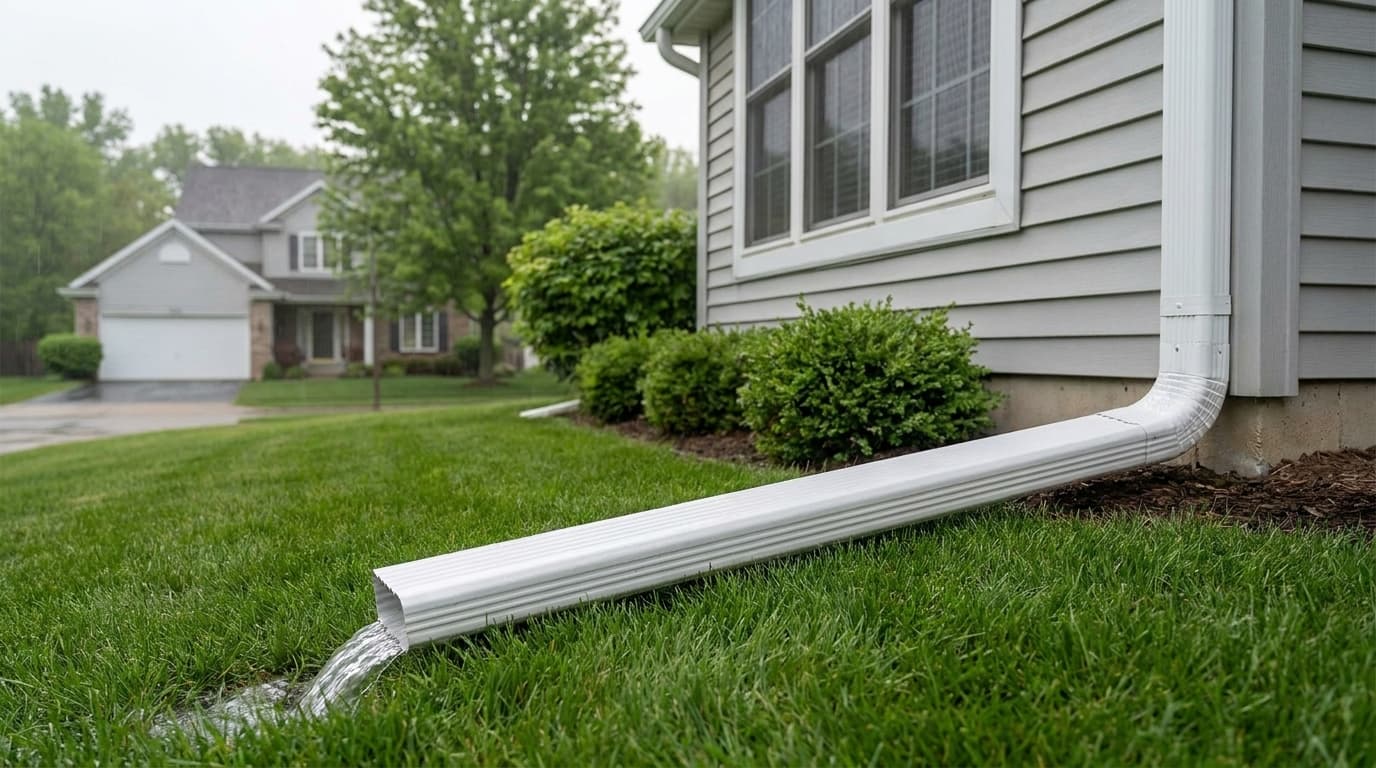
A downspout extension is the simple add-on that carries roof water four to six feet or more past your foundation instead of dumping it right at the wall — and it's one of the highest-value, lowest-cost upgrades an Ohio homeowner can make. Without it, even a perfectly clean, correctly sized gutter delivers a concentrated stream of water to the worst possible spot. In Cleveland, Columbus, and Dayton, getting that last few feet right is what actually keeps basements dry and foundations sound.
Homeowners spend real money on gutters, guards, and even foundation waterproofing while overlooking the cheapest fix of all: where the water lands when it leaves the downspout. A downspout that ends flush at the foundation might as well not exist, because it delivers hundreds of gallons of concentrated runoff to the exact place you're trying to protect. The extension is the difference between collecting water and actually getting rid of it.
Ohio's soils and storms make this the make-or-break step. Clay-heavy ground doesn't drain quickly, so water dumped at the wall lingers, saturates, and builds pressure. Add the region's intense summer downpours and hard winter freeze-thaw, and a few feet of extension becomes one of the most cost-effective forms of home protection you can buy.
Why a bare downspout isn't enough
It's tempting to think the downspout has done its job once the water reaches the ground. It hasn't.
Concentration is the problem
A gutter gathers the runoff from a large roof plane and funnels it into a single downspout — so the water leaving that spout is highly concentrated. Dropping it at the foundation is like aiming a garden hose at the base of your wall during every storm. The extension spreads that discharge out to where the soil can handle it.
Ohio soil holds water
Because much of Ohio sits on expansive clay, water discharged at the foundation doesn't soak away — it pools and saturates the soil against the wall, driving up hydrostatic pressure and, in winter, freezing and expanding against the foundation. Moving the discharge point away keeps that critical zone dry.
The four-to-six-foot rule
The general guideline is to carry water at least four to six feet from the foundation, and farther on flat lots or where soil drains poorly. The goal is to get the discharge past the backfilled zone of looser soil around the foundation and onto ground that slopes away.
Your drainage options, from simplest to most robust
There's a solution for every home and budget. Here's how they compare.
Splash blocks
A splash block is a simple sloped tray under the downspout that keeps water from digging a hole and nudges it away from the wall.
- Best for: homes with good grading that already slopes away.
- Limits: only moves water a foot or two — often not enough on its own.
Aluminum or vinyl extensions
Rigid extensions bolt onto the downspout elbow and carry water several feet out across the surface.
- Best for: most homes; cheap, effective, easy to install.
- Limits: visible on the lawn and can be in the way of mowing (hinged and roll-up versions solve this).
Flip-up and roll-out extensions
Hinged extensions flip up out of the way for mowing; roll-out sleeves unroll under water pressure and retract when dry.
- Best for: homeowners who want extensions that don't interfere with lawn care.
- Limits: the moving parts need occasional attention.
Buried drain lines
A solid PVC pipe buried underground carries water from the downspout to a discharge point well away from the house — often to daylight at the edge of the yard or to a dry well.
- Best for: flat lots, tight side yards, or homes where surface extensions aren't practical.
- Limits: higher cost, and the line must be kept clear of roots and silt to keep working.
Getting the details right
An extension only works if the rest of the setup cooperates. A few things to check:
- Slope the discharge away — the extension and the ground beyond it must fall away from the house, not toward it. Water will happily run back if the grade is wrong.
- Match the outlet size — a 6-inch gutter with 3x4 downspouts needs extensions sized to keep up, or you've moved the bottleneck.
- Don't discharge onto a walkway — in winter, that becomes an ice hazard across Ohio.
- Keep buried lines clear — underground drains clog silently; snake or flush them if a downspout starts backing up.
- Mind your neighbor and the property line — direct water to your own yard's low point, not toward an adjacent foundation.
Signs your drainage isn't working
Walk your foundation after the next hard rain and look for these telltales:
- Erosion trenches or splash craters below a downspout.
- Mulch or gravel washed away along the foundation line.
- Pooling water that sits against the wall long after the rain.
- A wet basement or damp spot that shows up only during storms.
- Ice sheets at the downspout base in winter — a sign water is discharging too close and too shallow.
Any of these means water isn't getting far enough from the house, and an extension or buried line is the fix.
Regional notes for Cleveland, Columbus, and Dayton
Cleveland
Cleveland's brutal freeze-thaw season makes downspout discharge placement critical. Water dumped at the foundation freezes and expands against the wall all winter, and shallow discharge onto walkways creates dangerous ice. Extensions that carry water well out onto sloping ground — and away from paths — are especially important here.
Columbus
Central Ohio's expansive clay soils saturate and swell during the long wet season, so Columbus homes benefit from getting discharge as far from the foundation as possible. On the metro's many flat suburban lots, buried drain lines to a daylight outlet or dry well often outperform short surface extensions.
Dayton
Dayton's intense storm bursts send a huge volume of water through the downspouts in a short time, so extensions and drain lines need the capacity to keep up. Pairing extended discharge with adequate downspout count and size ensures a Dayton home clears a heavy storm quickly instead of ponding water at the wall.
Frequently Asked Questions
How far should downspout extensions reach on a Cleveland home?
On a Cleveland home, extensions should carry water at least four to six feet from the foundation — and farther where the lot is flat. Because of Cleveland's freeze-thaw cycles, it's also important to keep discharge off walkways and driveways, where it turns to ice, and onto ground that slopes clearly away from the house.
Are buried drain lines worth it for a Columbus home?
For many Columbus homes on flat clay lots, buried drain lines are well worth it. They carry water to a daylight outlet or dry well far from the foundation, keep the lawn clear of surface extensions, and handle central Ohio's heavy rains better than short splash blocks. The main requirement is keeping the line clear of roots and silt.
Why does water pool at my Dayton downspout even with an extension?
If water still pools at a Dayton downspout with an extension in place, the usual causes are an extension that's too short for the storm volume, a discharge point that doesn't slope away, or an undersized outlet that can't keep up with the gutter. Dayton's intense bursts demand extensions matched to the downspout size and aimed at ground that clearly falls away.
Get the water where it belongs
Directing roof water away from your home is the simplest, cheapest step in protecting your foundation and basement — and it's easy to get wrong. If you're seeing pooling, erosion, or storm-driven basement moisture, the Zipco Gutters team is happy to look at your downspouts and drainage and recommend the right fix. Reach out for a free estimate in Cleveland, Columbus, or Dayton, and we'll help you send that water safely on its way.
Get a free gutter quote in your city
Serving Cleveland, Columbus, and Dayton with seamless aluminum gutters, written quotes, and a workmanship warranty.