
Central Ohio Clay: Why Columbus Downspouts Have to Reach Farther
Columbus sits on dense glacial clay that doesn't absorb water. Why standard splash blocks fail here, and how to route downspout discharge on a central Ohio lot.
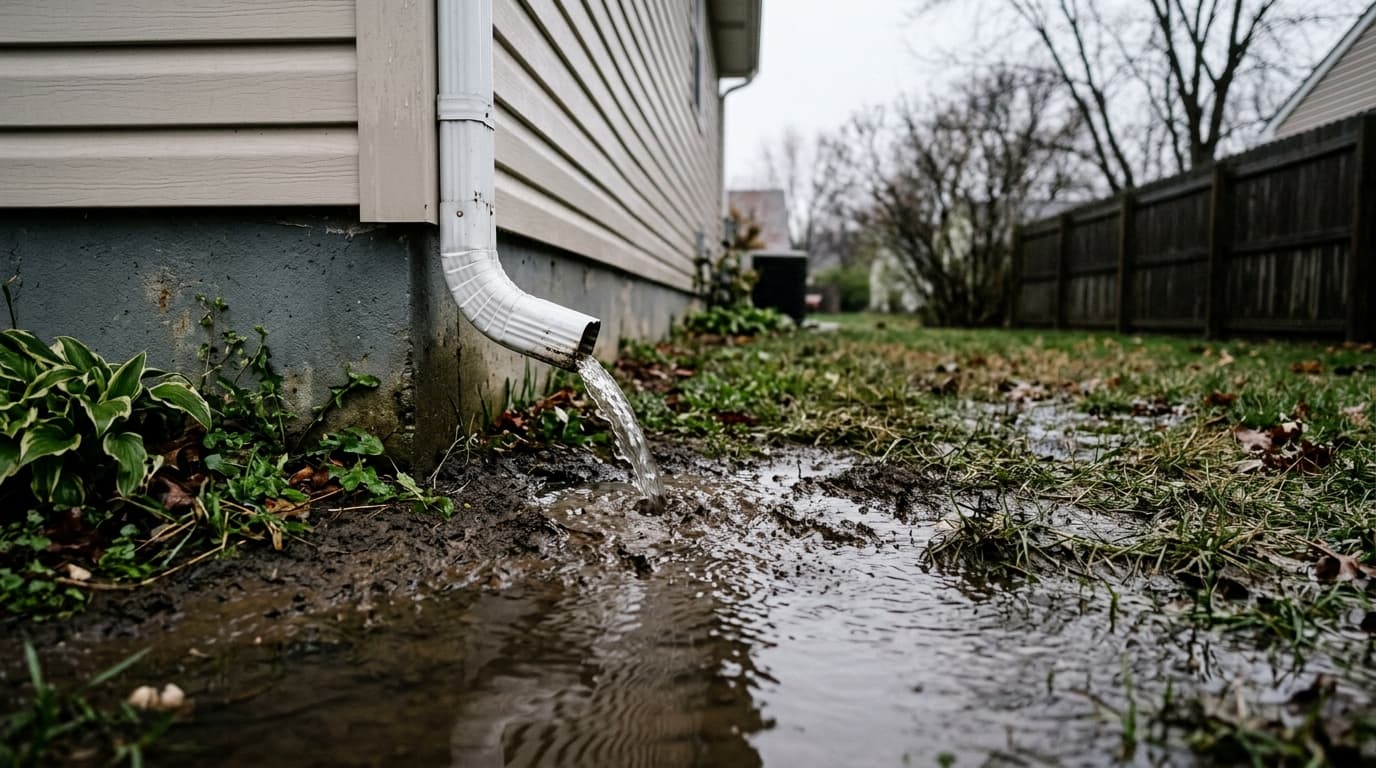
Central Ohio's soil is dense glacial clay, which means water that lands on your lawn largely stays on top of it and runs downhill instead of soaking in. On a Columbus-area lot, that makes the standard splash block essentially useless — roof water needs to be carried well away from the house, not just deflected a foot from the wall. It's the single most common drainage mistake we see in Franklin, Delaware, and Licking counties, and it's the cheapest one to fix.
Homeowners moving to Columbus from sandier parts of the country are often confused by how long puddles last here. The answer is under your feet: the glaciers that flattened central Ohio left behind a heavy, tight clay till with very low permeability. It holds water at the surface, it swells when wet and shrinks when dry, and it drains slowly enough that a hard rain can leave standing water in a yard for days.
Why clay changes the drainage math
Water doesn't go down, it goes sideways
In well-draining soil, water discharged near the house percolates downward and disperses. In central Ohio clay, it doesn't. It saturates the top few inches and then travels across the surface, following the grade to whatever low point exists — which, on a lot where the ground has settled toward the house, is your foundation wall.
The backfill trench is the weak point
This one is critical and widely misunderstood. When your house was built, a trench was excavated for the foundation and then backfilled with the loosened soil. That backfilled soil is permanently looser and more permeable than the undisturbed clay around it.
The result is what's sometimes called the "clay bowl" effect: the undisturbed clay acts like a basin, and the loose backfill ring around your foundation is the easiest path for water to travel downward. Every gallon you discharge at the base of the wall goes straight into that ring and down to your footing.
Clay moves
Clay soils expand when saturated and contract when they dry out. Repeated wet-dry cycling against a foundation wall puts real lateral pressure on it, and that cycling is worst exactly where you keep dumping and then not dumping water — right at the downspout discharge point.
How far is far enough?
The common advice is four to six feet from the foundation. In central Ohio clay, treat that as the minimum, not the target.
Practical guidance:
- Six to ten feet is a better working number on a typical Columbus-area lot.
- On a flat lot — and much of central Ohio is very flat — distance alone may not be enough, because the water has nowhere to go once it lands. It needs a defined destination.
- The discharge point must be lower than the foundation, and the ground between must slope away consistently. Discharging ten feet out into a spot that drains back toward the house accomplishes nothing.
- Watch it during a real rain. This beats every rule of thumb. If you see the discharge pooling, spreading, or heading back toward the house, it isn't far enough.
What actually works on a central Ohio lot
Above-ground extensions
Cheapest and easiest. Rigid or flexible extensions, ideally at least six feet, in a color that disappears against the mulch. The perpetual problem is that they get removed for mowing and never put back — solve that by choosing extensions that hinge up, or by committing to underground.
Buried drainage lines to daylight
The best answer on most Columbus-area lots. Solid (not perforated) pipe buried from the downspout out to a discharge point that daylights at a lower elevation, often at the back of the lot or toward a swale. Key points:
- Use solid pipe, not perforated. Perforated pipe surrounded by clay just deposits the water back in the ground near the house — the opposite of the goal.
- Maintain continuous fall the whole way. A buried line with a dip becomes a stagnant, freezing, root-catching liability.
- Include a cleanout or accessible connection. Buried lines eventually need to be flushed.
Dry wells
A gravel-filled pit that stores discharge and lets it seep out slowly. Honest assessment: dry wells underperform in dense clay because the surrounding soil can't absorb water fast enough. They can help buffer a moderate volume on a lot with no daylight option, but in central Ohio they're a compromise, not a solution.
Grading and swales
Sometimes the real fix isn't the downspout at all — it's that the yard directs water toward the house. Establishing positive grade away from the foundation for the first several feet, and cutting a shallow swale to carry surface water to a low point, addresses the whole lot rather than one discharge.
Know your subdivision's drainage plan
Newer Columbus-area developments are engineered with defined drainage easements, swales between lots, and retention or detention basins. That system works when it's intact. It stops working when someone fills in the swale for a nicer lawn, builds a shed across it, or landscapes over it. If your yard suddenly started holding water, look at what changed nearby — sometimes it's not your property.
The connection to your basement
Roof water is the water you have the most control over. A modest 1,500-square-foot roof sheds well over 900 gallons in a single inch of rain, and all of it exits through a handful of downspouts. Concentrating that volume at four points around your foundation, on soil that won't absorb it, is the leading preventable cause of wet basements in central Ohio.
If you have a sump pump that runs constantly during storms, the first thing to check is not the pump — it's where your downspouts discharge.
Frequently Asked Questions
How far should downspouts discharge from the house in Columbus?
Six to ten feet is a realistic target in central Ohio, not the commonly cited four. Clay soil doesn't absorb water, so discharge travels along the surface, and the loose backfill soil ringing your foundation is the easiest path down. On flat lots, distance alone isn't enough — the water needs a defined destination at a lower elevation.
Do dry wells work in central Ohio clay soil?
Not especially well. A dry well relies on surrounding soil absorbing the stored water, and dense glacial clay absorbs very slowly. They can buffer moderate volumes on a lot with no way to daylight a drainage line, but a buried solid pipe running out to a lower discharge point is a far more reliable solution here.
Why does water pool in my Columbus yard for days after it rains?
Because central Ohio sits on tight glacial clay with low permeability, and much of the region is very flat. Water sits on the surface rather than percolating down. It's normal for the soil type — but pooling near the foundation isn't something to live with, and roof runoff is usually the biggest and most controllable contributor.
Solve it where it starts
If your Columbus-area yard holds water, your sump runs nonstop, or you're seeing dampness in the basement, the Zipco Gutters of Columbus team can look at the whole path — gutter capacity, downspout count, and where the water actually ends up. Reach out for a free estimate.
Get a free gutter quote in your city
Serving Cleveland, Columbus, and Dayton with seamless aluminum gutters, written quotes, and a workmanship warranty.