
Downspout Placement and Sizing: The Overlooked Half of Your Gutter System
Why downspout placement and sizing make or break your gutter system — an Ohio guide for Cleveland, Columbus & Dayton homeowners on drainage done right.
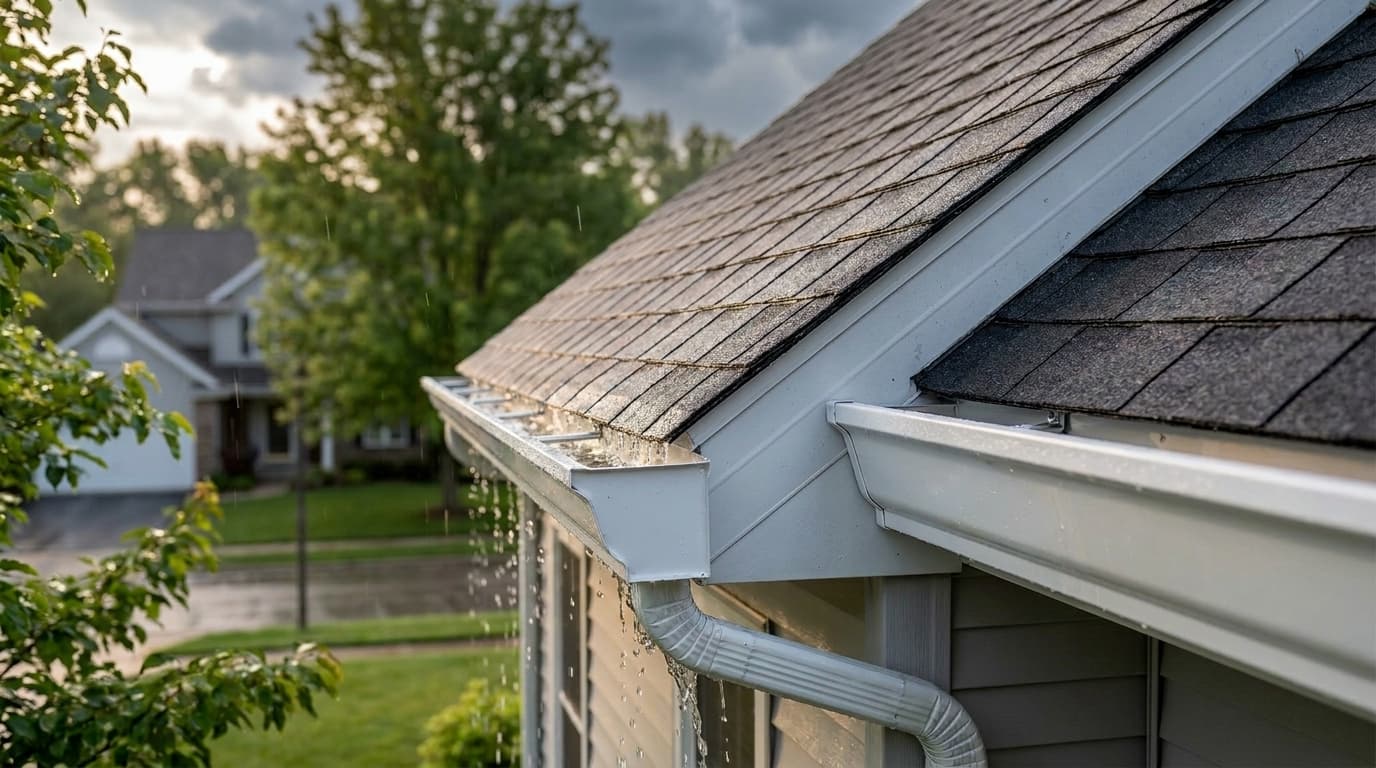
Your downspouts are half the drainage system, and if they're too few, too small, or poorly placed, even perfectly sized gutters will overflow and dump water at your foundation. The general rules: one downspout for roughly every 30 to 40 feet of gutter, sized to match the trough (2x3 for 5-inch gutters, 3x4 for 6-inch), and positioned so water discharges at least four to six feet from the house. Get those three things right and your gutters can actually do their job in an Ohio storm.
Homeowners obsess over gutter size and barely think about downspouts, but the downspout is the bottleneck. A gutter only holds water for a moment — its whole purpose is to route runoff to a downspout and get it off the roof. If the downspouts can't drain the trough as fast as the roof fills it, the gutter backs up and spills over, and you'll swear the gutter is "too small" when the real problem is downstream. In Cleveland, Columbus, and Dayton, where short intense downpours are the norm, downspout capacity is what separates a system that keeps up from one that fails during the exact storms you need it for.
How many downspouts do you actually need?
The rough industry guideline is one downspout for every 30 to 40 feet of gutter run. But that's a starting point, not a law. The real drivers are how much roof drains into a given run and how steep the roof is.
When you need more than the minimum
- Long runs. A 50-foot run with a single downspout at one end forces all that water to travel the length of the gutter. Add a second downspout so each half of the run drains independently.
- Big roof planes or valleys. A roof valley concentrates water into a narrow, fast stream. A run catching a valley may need a downspout right where the valley dumps, regardless of total footage.
- Steep pitches. Steep roofs deliver water faster, so the gutter fills quicker and needs more frequent drainage points.
- History of overflow. If a particular stretch of gutter has always spilled over in hard rain, it's usually starved for downspouts, not undersized.
The math, simply
More downspouts mean each one carries less water and the gutter never has to hold much volume at once. It's almost always cheaper and more effective to add a downspout than to size up the whole gutter. Downspouts are the highest-leverage, lowest-cost part of the system.
Sizing: match the downspout to the gutter
A downspout has to keep pace with its trough, or you've built in a bottleneck.
- 2x3 downspouts pair with 5-inch gutters. Fine for small ranches and simple rooflines.
- 3x4 downspouts pair with 6-inch gutters and move roughly twice the water of a 2x3. This is increasingly the Ohio default.
- Round or oversized downspouts show up on larger homes, copper systems, and high-runoff situations.
If you upgrade to 6-inch gutters but leave 2x3 downspouts on, you haven't really upgraded — you've just moved the bottleneck down a few feet. Sizing the gutter and downspout together is the whole point.
Placement: get the water away from the house
Where a downspout drops and where it discharges are two different decisions, and both matter.
Where the downspout drops
- Put drops at corners and low points where water naturally collects, but keep them off the most visible facade where practical.
- Avoid draining a downspout over a walkway or driveway, where the discharge will ice over in an Ohio winter and become a slip hazard.
- Don't cluster the drops; spread them so each serves a manageable length of gutter.
Where the water discharges (this is the part people skip)
Getting water into the downspout is meaningless if it dumps right at the foundation. The discharge point should carry water well clear of the house:
- Splash blocks move water a short distance and prevent soil erosion at the base — the minimum acceptable solution.
- Downspout extensions (four to six feet) are better, carrying water past the backfill zone where foundation seepage starts.
- Underground drain lines to a pop-up emitter or a proper daylight discharge are the best solution, especially on flat lots — they move water 10-plus feet away and keep the yard usable.
The goal is simple: no water should be soaking into the ground within a few feet of your foundation. That backfill soil is the most permeable path straight into your basement.
The winter wrinkle in Ohio
Downspouts and Ohio winters have a complicated relationship. Water that discharges onto a walkway freezes into a hazard. Underground drain lines can freeze solid and back water up into the gutters, causing ice buildup at the eave. The fixes: keep discharge points off paths, make sure underground lines have enough slope to drain fully (no standing water to freeze), and consider a downspout that can be diverted or disconnected from a frozen underground line in deep winter.
Regional notes for Cleveland, Columbus, and Dayton
Cleveland
Cleveland's freeze-thaw cycles and lake-effect precipitation put underground downspout drains at risk of freezing and backing up, so proper slope and a winter bypass plan matter more here than almost anywhere in the state. Discharging away from walkways is also critical given how much of the season involves ice underfoot.
Columbus
Columbus's intense summer thunderstorms are the real stress test for downspout capacity. Homes with long gutter runs and only one or two downspouts are the ones that overflow during those central-Ohio downpours — adding drops is usually the fastest fix. Many Columbus subdivisions also have tight lot spacing, making underground drainage to a daylight point worthwhile.
Dayton
Dayton's heavy storms and flatter lots in some neighborhoods mean water pools easily near foundations if downspouts discharge too close to the house. Extensions or underground lines that carry water well clear of the backfill are a smart investment, and 3x4 downspouts help the system recover quickly from the region's high-volume rain events.
Frequently Asked Questions
How many downspouts does a Cleveland home need?
Most Cleveland homes need one downspout for every 30 to 40 feet of gutter, but long runs, steep roofs, and valleys often call for more. Because Cleveland's freeze-thaw cycles stress underground drains, it's also worth making sure discharge points are well away from walkways and have enough slope to drain fully before winter.
What size downspouts are best for a Columbus home?
For most Columbus homes with 6-inch gutters, 3x4 downspouts are the best match — they move about twice the water of a 2x3, which matters during central Ohio's intense summer storms. Smaller Columbus ranches with 5-inch gutters and simple rooflines can still drain well with 2x3 downspouts.
How far should downspouts discharge from a Dayton foundation?
Downspouts on a Dayton home should discharge at least four to six feet from the foundation, and farther is better on flatter lots. Extensions or underground drain lines that carry water past the backfill zone are the most reliable way to keep Dayton's heavy storm runoff from pooling against the house.
Let's look at the whole system, not just the gutter
Downspouts are the quiet half of the job, and they're where a lot of "my gutters don't work" problems actually live. If your Cleveland, Columbus, or Dayton home overflows in hard rain or pools water near the foundation, the Zipco Gutters team is happy to walk the system, count the drops, check the sizing, and tell you honestly what it needs — often a simpler and cheaper fix than you'd expect.
Get a free gutter quote in your city
Serving Cleveland, Columbus, and Dayton with seamless aluminum gutters, written quotes, and a workmanship warranty.