
Gutter Guard Types Compared: Aluminum Panel, Mesh, Screen, Reverse-Curve, and Foam
Aluminum panel, micro-mesh, screen, reverse-curve, or foam gutter guards? An honest Ohio comparison for Cleveland, Columbus & Dayton homeowners choosing leaf protection.
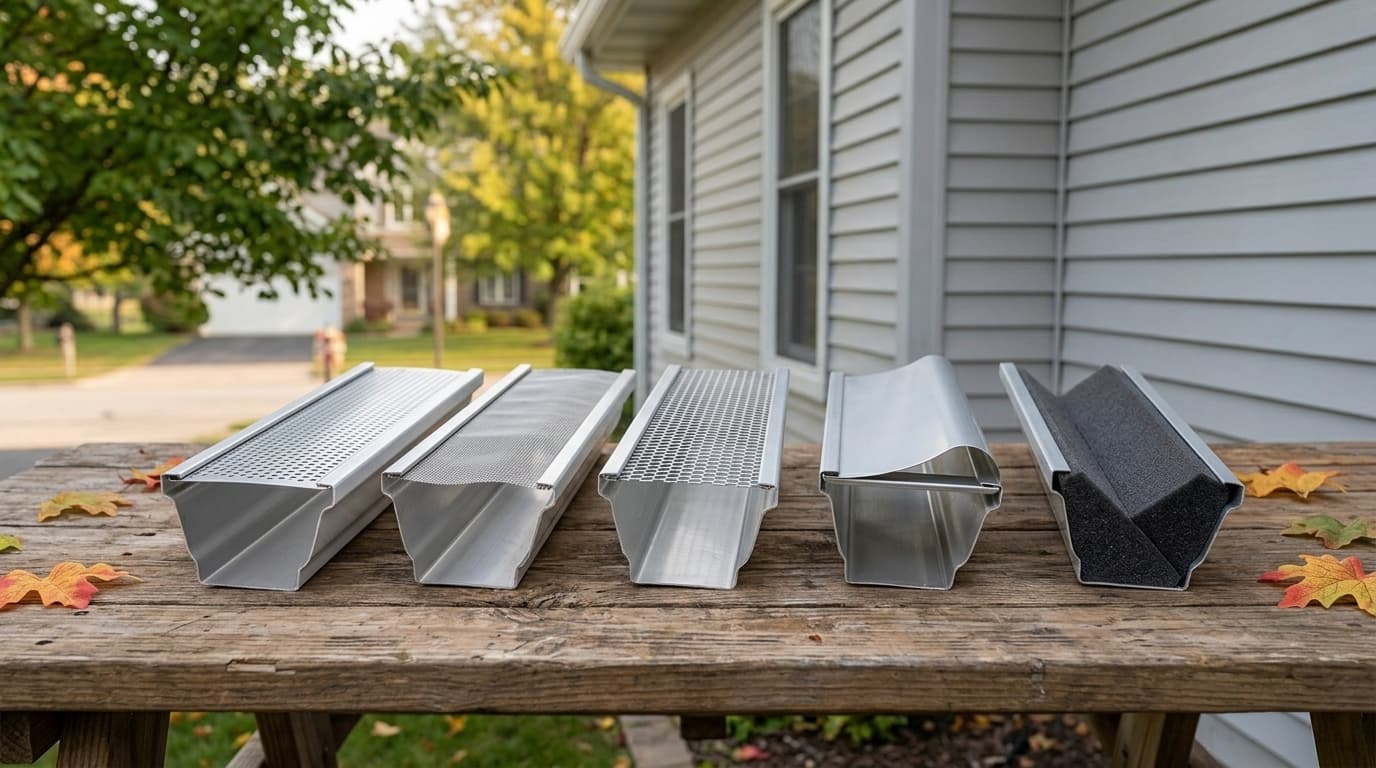
The main gutter guard types — perforated aluminum panel, micro-mesh, screen, reverse-curve, and foam — vary widely in price, durability, and how well they handle Ohio's mix of leaves, maple seeds, and pine needles, and for most Ohio homes a perforated aluminum panel offers the best all-around performance. Screen guards are a budget middle ground, reverse-curve guards shed leaves well but struggle with fine debris, micro-mesh filters everything but tends to blind over, and foam is cheap but short-lived. The right pick for your Cleveland, Columbus, or Dayton home depends on your trees, your budget, and how much maintenance you're willing to do.
Every fall, Ohio homeowners climb ladders they'd rather avoid to scoop wet leaves out of their gutters. Gutter guards promise to end that chore — and the good ones largely do. But "gutter guard" covers several very different products at very different price points, and the marketing rarely explains the trade-offs honestly. Here's a straight comparison so you can choose based on how your home actually sheds debris.
First, what gutter guards can and can't do
No guard makes a gutter truly maintenance-free, and any company that promises "never clean your gutters again" is overselling. What good guards do is dramatically reduce how often, and how dangerously, you have to maintain the system. They keep the bulk of leaves and debris out, so instead of digging sludge out of the trough four times a year, you might rinse the tops once in a while. That's a real quality-of-life difference — just not magic.
Guards also perform better on properly sized gutters. A 6-inch gutter with 3x4 downspouts gives leaves more room to slide off and water more room to enter, so guards and correct sizing work best as a package.
The main types, compared honestly
Perforated aluminum panels
A perforated aluminum panel is a heavy-gauge aluminum cover with hundreds of precision openings per foot. Water drains straight through the perforations at storm-flow rates while leaves, needles, and seed pods ride on top. The panel's contoured profile keeps air moving both above and below it, so what lands on top dries out and blows off in a light breeze instead of matting down into compost.
The other structural advantage: it fastens to the gutter itself rather than being lifted or slid under your shingles, so your roof warranty stays intact.
- Strengths: Excellent water throughput, debris dries and blows clear rather than accumulating, solid aluminum won't rust or warp, no fine screen to blind over, mounts to the gutter and not the roof.
- Weaknesses: A professional-install product, so it costs more upfront than screen or foam; very fine dust and pollen can still leave a film worth rinsing occasionally.
- Best for: Most Ohio homes, and especially mixed canopies with both hardwoods and evergreens.
This is the style we install as Zipco Leaf Shield, and it's what we recommend for the large majority of Cleveland, Columbus, and Dayton homes.
Micro-mesh guards
Micro-mesh guards use a very fine stainless-steel mesh over a sturdy frame that clips or screws onto the gutter. The tiny openings block almost everything — leaves, maple seeds, shingle grit, even pine needles.
On paper that sounds ideal, and micro-mesh does filter more finely than anything else on this list. In practice, that same fineness is the catch in Ohio. Shingle grit, pollen, and the organic film that comes off a wet roof gradually blind the mesh, so water starts sheeting over the top of a guard that looks clean from the ground. Wet leaves also tend to mat on the surface rather than blowing clear, because there's no meaningful airflow under a flat screen.
- Strengths: The finest filtration available; blocks debris nothing else catches; durable metal construction.
- Weaknesses: The mesh can blind over with grit and pollen over time; debris mats on top rather than blowing off; when it does need cleaning, a fine screen is genuinely tedious to clear.
- Best for: Situations where filtering the absolute finest debris outweighs the upkeep — it's a legitimate product, but it's the one we stopped installing after seeing how it ages on real Ohio roofs.
Screen guards
Screen guards are perforated panels — metal or plastic — that lay over the gutter with much larger holes than a mesh or a precision-perforated panel. They're the classic middle-of-the-road option.
- Strengths: Affordable, easy to install, keep out larger leaves and twigs.
- Weaknesses: Larger holes let small debris — maple seeds, pine needles, grit — pass through and still clog the trough; plastic versions get brittle in Ohio's cold.
- Best for: Homes with mostly large-leaf trees and a modest budget.
Reverse-curve guards
Reverse-curve (or surface-tension) guards use a solid curved hood that guides water around the lip and into the gutter while leaves tumble off the edge.
- Strengths: Shed large leaves very effectively; sturdy; handle heavy water flow.
- Weaknesses: Fine debris like seeds and needles can ride the water into the gutter; the visible hood can be noticeable from the ground; performance drops in very heavy downpours if water overshoots.
- Best for: Homes under large-leaf trees without many pines or seed-heavy maples.
Foam guards
Foam guards are triangular foam inserts that sit inside the gutter, blocking debris while letting water pass through the foam. They're the cheapest, most DIY-friendly option.
- Strengths: Very low cost, easy to install yourself, no special tools.
- Weaknesses: Shortest lifespan; foam degrades in UV and cold, holds moisture, can grow debris and even seedlings on top, and clogs with fine material. Often needs replacing in just a few years.
- Best for: Temporary fixes or very tight budgets, not long-term Ohio performance.
How Ohio debris should drive your choice
The single most important factor is what falls on your roof. Ohio's mix is tougher than most homeowners realize.
Match the guard to your trees
- Big-leaf hardwoods only (oaks, sycamores, large maples): screen or reverse-curve can work.
- Seed-heavy maples (those spring "helicopters"): you need a precision-perforated aluminum panel — larger screen openings let seeds straight through.
- Pines, spruces, or firs: needles defeat most guards; a perforated panel that lets needles dry and blow off handles them better than a screen they can weave into.
- Mixed canopy (typical for older Ohio suburbs): a perforated aluminum panel handles the widest range.
Don't forget winter
Ohio guards have to survive freeze-thaw, snow load, and ice. Solid aluminum panels and quality reverse-curve guards handle this well. Plastic screens get brittle and crack, and foam breaks down — both are false economies in a state with real winters.
A quick decision framework
- Look up at your trees. Note whether you have fine debris (seeds, needles) or just big leaves.
- Set your horizon. Want a 20-year solution or a few-year patch? That rules foam in or out fast.
- Ask how the guard sheds what lands on it. A guard that traps debris on its surface needs cleaning; one with airflow above and below lets it blow away.
- Size the gutters too. Guards work best on 6-inch gutters with 3x4 downspouts.
- Get a professional assessment. A good installer will look at your specific roof and trees and tell you honestly which guard fits — not just which one they'd rather sell.
Regional notes for Cleveland, Columbus, and Dayton
Cleveland
Cleveland's mature east-side tree canopy and heavy lake-effect winters are a double challenge: lots of fine debris in the fall, then serious ice load in winter. Solid aluminum panels handle both better than plastic screens or foam, which crack and degrade in the north coast's harsh freeze-thaw. Durability is the priority here.
Columbus
Columbus neighborhoods like Clintonville and Upper Arlington sit under seed-heavy maples and oaks that overwhelm large-hole screen and reverse-curve guards every spring. For central Ohio's mixed canopy, a perforated aluminum panel is usually the most reliable choice, keeping both the spring "helicopters" and the fall leaves out of the trough.
Dayton
Dayton's mix of large sycamores, silver maples, and pines means a lot of fine debris, and the region's severe storms test how well any guard stays put. A heavy-gauge perforated panel handles the needles and seeds, and a securely fastened aluminum system stands up better to southwest Ohio's high winds than lightweight foam or brittle plastic.
Frequently Asked Questions
Which gutter guard is best for a wooded lot in Cleveland?
For a wooded Cleveland lot, a heavy-gauge perforated aluminum panel is usually the best choice. It keeps maple seeds, pine needles, and leaves on top where airflow lets them dry and blow off, and its solid aluminum construction survives the north coast's heavy freeze-thaw and snow load far better than plastic or foam.
Are reverse-curve gutter guards a good option in Columbus, Ohio?
Reverse-curve guards can work in Columbus if your trees are mostly large-leaf hardwoods, since they shed big leaves well. But central Ohio's seed-heavy maples and mixed canopy send fine debris riding the water into the gutter, which reverse-curve guards don't filter. A perforated aluminum panel handles that mix more reliably for most Columbus homes.
Do foam gutter guards hold up in Dayton winters?
Not well. Foam guards degrade in UV and cold, hold moisture, and can grow debris and seedlings on top, often needing replacement within a few years. In Dayton's storm-prone, freeze-thaw climate, a solid perforated aluminum panel is a far more durable long-term investment than foam.
Choosing the right protection
Gutter guards are only as good as the match to your home and trees. The Zipco Gutters team will look at your Cleveland, Columbus, or Dayton property, factor in your canopy and your winters, and give you a straight recommendation — no overselling. Reach out for a free estimate and honest guidance on whether Zipco Leaf Shield is the right fit for your roofline.
Get a free gutter quote in your city
Serving Cleveland, Columbus, and Dayton with seamless aluminum gutters, written quotes, and a workmanship warranty.