
Seamless vs. Sectional Gutters: Why the Joints Matter for Ohio Homes
Seamless vs. sectional gutters in Ohio — why the joints matter. A clear comparison for Cleveland, Columbus & Dayton homeowners weighing leaks and cost.
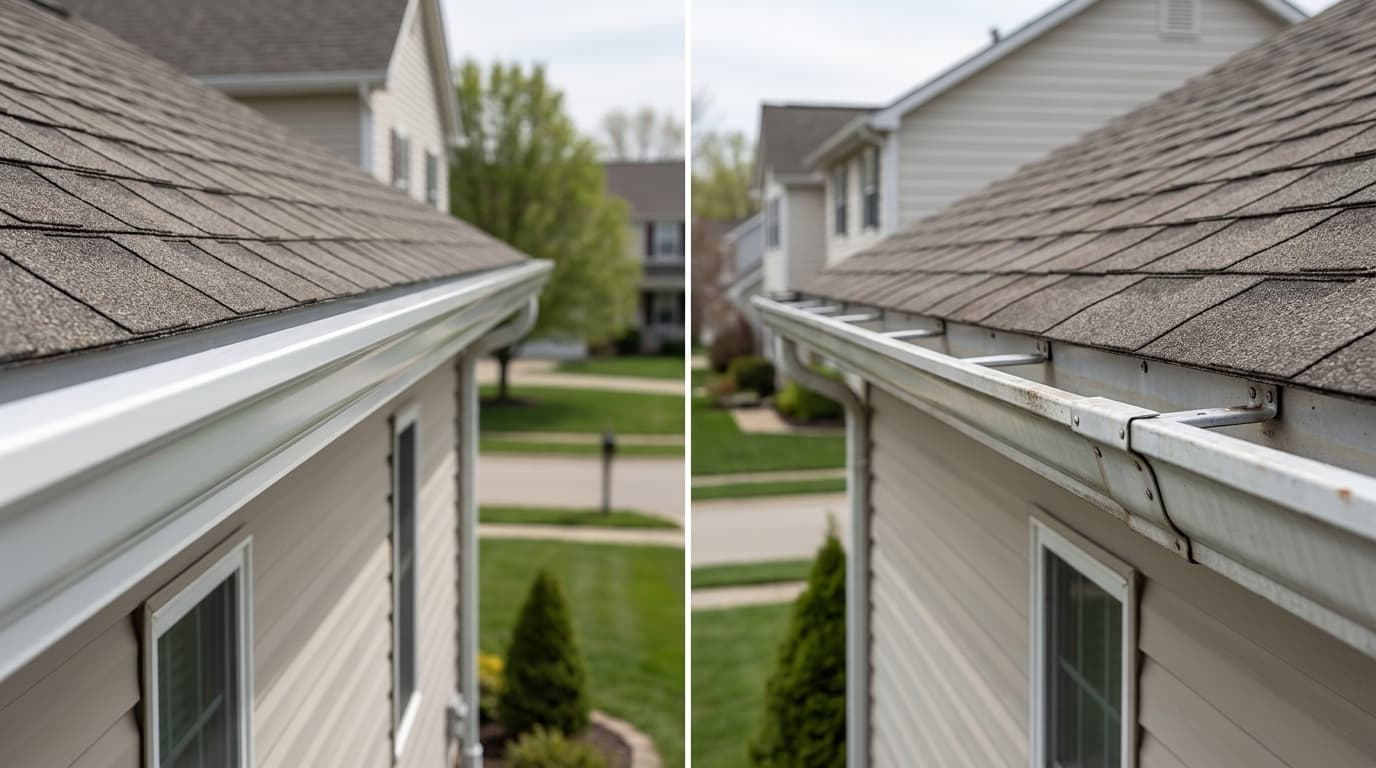
Seamless gutters are the better choice for almost every Ohio home, because they're formed as one continuous piece with no joints along the runs — and joints are exactly where sectional gutters leak, clog, and fail under Ohio's freeze-thaw cycles. Sectional gutters cost a little less upfront and can be DIY-installed, but they trade that savings for more seams, more maintenance, and a shorter life. For homeowners in Cleveland, Columbus, and Dayton dealing with hard winters and heavy summer storms, the joints are the whole story.
Walk down any Ohio street and you're looking at both kinds of gutters, often without realizing it. The older home with the dark drip stains every ten feet along the fascia? Those are almost certainly sectional gutters leaking at their seams. The newer install with the clean, unbroken line? Seamless. Understanding the difference — and specifically why seams matter so much in Ohio — helps you make a decision that holds up for decades.
What "seamless" and "sectional" actually mean
The names describe exactly how each gutter is built, and that construction drives everything else.
Sectional gutters
Sectional gutters come in pre-made lengths — typically 10 feet — that are joined together on your house with connectors and sealant. A long run might have a seam every ten feet. They're sold at home-improvement stores, which is why they're the DIY default, and they've been around for generations.
Seamless gutters
Seamless gutters are formed on-site. A crew brings a portable roll-forming machine, feeds in a coil of aluminum, and produces a single continuous length of gutter cut to the exact measurement of each run. A 40-foot side of your house gets one 40-foot piece of gutter — no joints in the middle at all. The only seams in a seamless system are at inside and outside corners and at the downspout outlets, which are sealed and flashed.
Why joints are the weak point in Ohio
Every seam is a place where two pieces of metal meet, held together by sealant. And sealant is the part that Ohio weather attacks relentlessly.
Freeze-thaw is brutal on seams
Ohio swings above and below freezing dozens of times each winter. Water sitting in a joint freezes, expands, and pushes the seam apart, then thaws and does it again the next day. Over a few winters, this freeze-thaw cycle degrades the sealant, opens hairline gaps, and starts the drip. Cleveland's lake-effect winters make this even harsher, but every Ohio metro sees it.
Seams leak, and leaks cause real damage
A leaking seam doesn't just drip — it sends water straight down the fascia board behind the gutter. That's the leading cause of fascia rot, soffit damage, and eventually water intrusion in Ohio homes. What starts as a $5 tube of sealant problem becomes a fascia-replacement problem if it's ignored.
Seams catch debris and clog
Internal seam connectors create small ledges and lips inside the gutter — exactly where leaves, seeds, and shingle grit snag and build a dam. Seamless gutters have a smooth interior along the entire run, so debris flows more freely toward the downspout.
The honest case for and against each
Seamless isn't perfect for literally every situation, and it's worth being straight about the trade-offs.
Where sectional still makes sense
- Very short runs — a small porch or shed roof where a seam or two is trivial.
- Tight DIY budgets — sectional is the practical choice if you're doing it yourself and can't rent forming equipment.
- Temporary fixes — patching one section while planning a full replacement.
Why seamless wins for whole-home installs
- Far fewer leak points — only corners and outlets, not every ten feet.
- Longer life — quality seamless aluminum lasts 20–30 years in Ohio.
- Less maintenance — fewer seams to reseal, fewer clogs to clear.
- Custom fit — formed to your exact roofline for a clean, tight look.
- Better resale appeal — the unbroken line reads as a well-maintained home.
The upfront cost difference is real but usually modest, and it's typically recovered through lower maintenance and longer replacement intervals. Because seamless requires the forming machine and skilled installation, it's a professional job — not a weekend project.
What to look for in a seamless install
Choosing seamless is step one; a good installation is step two. Ask about:
- Aluminum gauge — .032 is a heavier, dent-resistant upgrade over the .027 builder default, worth it under Ohio ice load.
- Corner and outlet sealing — since these are your only seams, they must be properly sealed and flashed.
- Hanger spacing — hidden hangers spaced correctly keep long seamless runs from sagging under snow.
- Downspout sizing — 3x4 downspouts on 6-inch gutters move water fast enough to keep up with Ohio storms.
- Proper slope — even a seamless gutter needs the right pitch toward the downspout to drain fully.
Regional notes for Cleveland, Columbus, and Dayton
Cleveland
Cleveland's severe freeze-thaw cycles and lake-effect winters are the hardest test of any gutter seam in the state. Sectional joints here fail faster than almost anywhere in Ohio, which is why seamless — with its handful of well-sealed corners — is such a clear win on the north coast. Heavier-gauge aluminum adds durability against ice load.
Columbus
Columbus homeowners weighing a switch often discover their recurring "clog" and "overflow" complaints are actually seam leaks on aging sectional gutters. Central Ohio's heavy summer downpours expose weak joints quickly. Moving to seamless typically solves the leaks and the drip stains in one project.
Dayton
Dayton's high winds and hail put mechanical stress on gutters, and sectional connectors are the first thing to separate in a severe storm. Seamless runs have fewer failure points to pull apart, and paired with heavier-gauge aluminum and reinforced hangers, they hold up better through southwest Ohio's storm seasons.
Frequently Asked Questions
Are seamless gutters worth the extra cost in Cleveland?
For most Cleveland homes, yes. The area's severe freeze-thaw and lake-effect winters destroy sectional seams faster than almost anywhere in Ohio, so the leak-prone joints you'd pay to reseal repeatedly simply don't exist on a seamless system. The modestly higher upfront cost is usually recovered in lower maintenance and longer life.
Why do my sectional gutters keep leaking at the joints in Columbus?
In Columbus, the culprit is almost always freeze-thaw stress breaking down the sealant at each connector, worsened by heavy summer downpours forcing water through the weakened seams. Resealing buys a season or two at best. Switching to seamless removes the mid-run joints entirely, which usually ends the recurring leaks.
Can seamless gutters be installed on an older Dayton home?
Absolutely. Seamless gutters are formed on-site to fit any roofline, including older Dayton homes with complex or irregular eaves. The installer measures each run, forms it to the exact length, and seals only at the corners and downspouts — often a major upgrade over failing sectional gutters on an older house.
The joints make the difference
If your Cleveland, Columbus, or Dayton gutters are leaking every ten feet, the seams are telling you it's time. The Zipco Gutters team forms true seamless aluminum gutters on-site, fitted to your exact roofline. Reach out for a free estimate and see the difference fewer joints make.
Get a free gutter quote in your city
Serving Cleveland, Columbus, and Dayton with seamless aluminum gutters, written quotes, and a workmanship warranty.