
Why Your Gutters Overflow During Ohio Summer Storms (and How to Stop It)
Why do Ohio gutters overflow in summer storms? A Cleveland, Columbus & Dayton homeowner's guide to the real causes — clogs, undersizing, pitch, and downspouts.
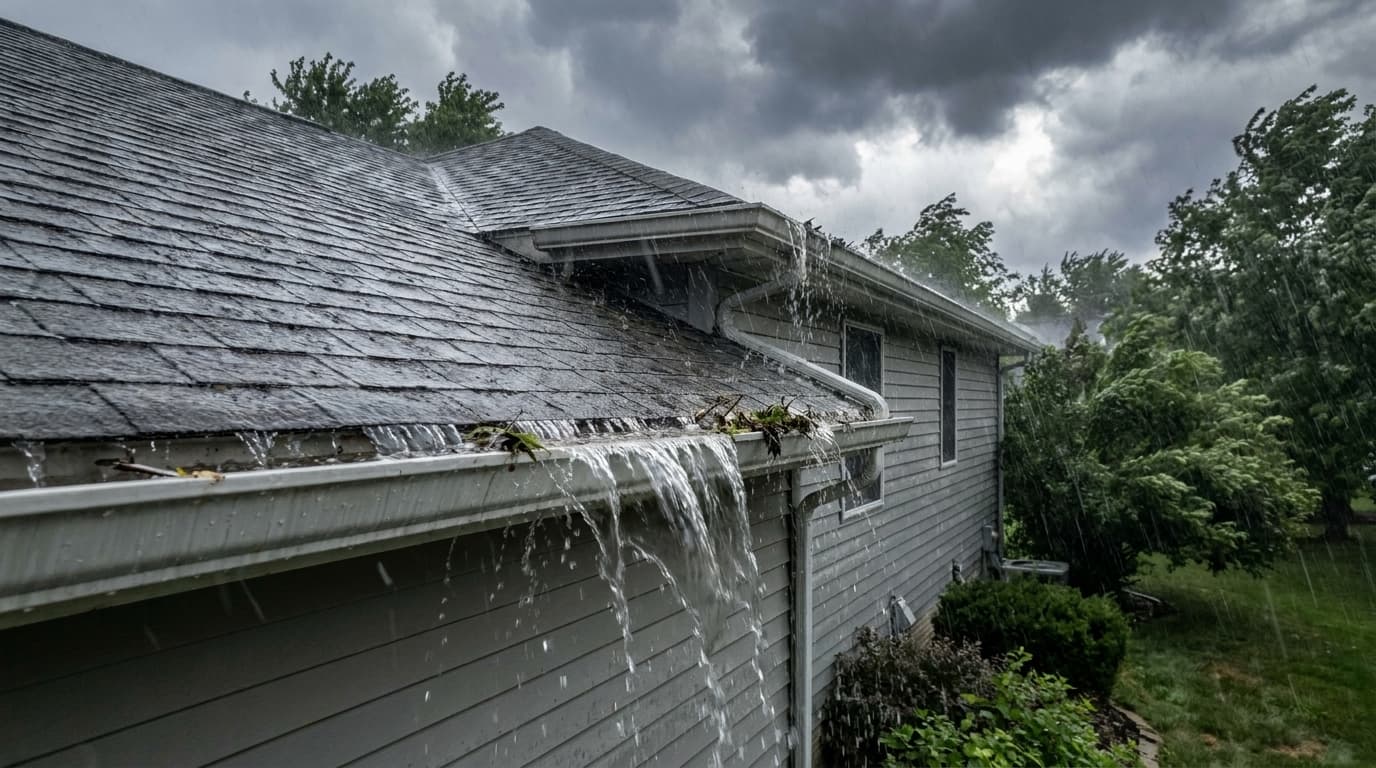
Ohio gutters overflow in summer storms for one of four reasons: they're clogged with debris, they're too small for the roof, they've lost their pitch and hold standing water, or the downspouts can't drain fast enough. Nine times out of ten it's a clog or a capacity problem, and both are fixable. The key is figuring out which one is soaking your Cleveland, Columbus, or Dayton home so you solve the actual cause instead of guessing.
If you've stood at a window during a July thunderstorm and watched water pour over the front lip of your gutter like a little waterfall, you know the sight is alarming. That sheet of water isn't landing in a flower bed — it's hitting the siding, splashing the foundation, and finding its way toward the basement. Overflow is your gutter telling you it's overwhelmed.
Ohio summers deliver exactly the kind of rain that exposes a weak gutter system. It's not the annual total that matters; it's the intensity. A central Ohio thunderstorm can drop an inch of rain in under an hour, and Dayton's severe-weather setups can push far harder in short bursts. A gutter that coasts through a gentle spring drizzle can be completely overrun by ten minutes of that.
Cause 1: Clogs and debris
This is the most common culprit and the easiest to confirm. Leaves, seed pods, roof grit, and windblown debris build up in the trough and — more importantly — jam the downspout outlets.
How to spot a clog
- Water overflows at a specific spot every time, usually near a downspout.
- The overflow starts almost as soon as it rains, not just during the heaviest bursts.
- You can see debris, plant growth, or a dark waterline in the trough.
- Tapping the downspout produces a dull thud instead of a hollow ring.
The fix
Clean the gutters and clear the downspout openings, then run a hose to confirm free flow. If you're cleaning more than twice a year, it's worth considering gutter guards to keep the trough clear between storms — a perforated aluminum panel guard dramatically cuts how often debris reaches the water, while still passing a hard Ohio downpour at full flow.
Cause 2: The gutters are undersized
Sometimes the gutter is clean and still overflows. That's a capacity problem — the trough simply can't hold the volume rolling off your roof during a hard Ohio downpour.
Why size matters in summer
A standard 5-inch K-style gutter is fine for many small ranches, but a large or steep roof feeds it faster than it can drain. A 6-inch gutter carries roughly 40% more water and pairs with a larger 3x4 downspout, giving you the headroom summer storms demand. Homes with big roof planes, multiple valleys, or two full stories are the usual candidates for overflow from undersizing.
The tell
If overflow happens only during the heaviest bursts and shows up along a long stretch of the run rather than one spot, undersizing is the likely cause. Roof valleys that concentrate water into a narrow stream are especially prone to overrunning a 5-inch gutter.
Cause 3: Lost pitch and standing water
Gutters are hung with a slight slope so water always moves toward a downspout. Over years of ice loading and settling — common across Ohio — hangers loosen and the trough develops a low belly that holds standing water.
What goes wrong
Standing water leaves no room for the next storm's runoff, so even a modest rain overflows the low spot. Standing water also breeds mosquitoes, adds weight that pulls the gutter further from the fascia, and speeds corrosion at the seams.
The fix
Re-secure the hangers and restore the correct slope — about a quarter inch of drop per 10 feet toward the nearest downspout. Adding hidden hangers every two feet keeps the run from sagging again under summer rain and future ice.
Cause 4: Downspouts that can't keep up
You can have a clean, correctly sized, well-pitched gutter and still overflow if the downspouts are the bottleneck. The trough fills faster than the drains can empty it.
Common downspout problems
- Too few downspouts for the roof area — every long run needs a drain at each end.
- Undersized 2x3 downspouts paired with a 6-inch gutter (a mismatch that chokes flow).
- Buried underground drains that are themselves clogged with roots or silt.
- Kinked or crushed elbows from ladders or storm debris.
The fix
Add downspouts to long runs, upsize to 3x4 outlets on 6-inch gutters, and confirm any underground drain lines actually carry water away. More drainage points is almost always money well spent.
Regional notes for Cleveland, Columbus, and Dayton
Cleveland
Cleveland gutters carry the aftermath of a long winter into storm season — sagged runs and loosened hangers from months of ice load. That lost pitch turns into standing water and overflow the first time a heavy summer system moves off the lake. A spring pitch check before the rains is the best defense.
Columbus
Central Ohio's fast, high-intensity thunderstorms are the classic overflow trigger in Columbus. Many overflow calls here trace back to undersized 5-inch gutters on larger suburban homes that simply can't handle an inch of rain in forty minutes. Upsizing to 6-inch with 3x4 downspouts solves it for good.
Dayton
Dayton sees the most severe storm bursts of the three metros, so downspout capacity matters most here. High winds also drop debris into the trough mid-storm, creating instant clogs. Heavier-gauge gutters and extra downspouts help Dayton homes recover faster between the back-to-back systems that roll through in summer.
Frequently Asked Questions
Why do my Cleveland gutters overflow even after I clean them?
If your Cleveland gutters are clean and still overflow, the cause is usually lost pitch or undersizing. A winter of ice loading often leaves runs sagging with standing water, and older homes frequently have 5-inch gutters that can't handle heavy summer rain. Re-pitching the run or upsizing to 6-inch typically fixes it.
Will bigger gutters stop overflow on my Columbus home?
For many Columbus homes, yes — if your gutters overflow along a long stretch during heavy bursts rather than at one clogged spot, upsizing from 5-inch to 6-inch gutters with 3x4 downspouts adds about 40% more capacity. That's usually enough to handle central Ohio's high-intensity thunderstorms.
How many downspouts should a Dayton home have to prevent overflow?
As a rule of thumb, every long gutter run in Dayton should drain to a downspout at each end, and no single downspout should serve more than about 30-40 feet of gutter. Given Dayton's severe storm bursts, adding downspouts and upsizing to 3x4 outlets is one of the most effective ways to stop overflow.
Stop the waterfall before it costs you
Overflowing gutters aren't just annoying — they quietly damage siding, fascia, and foundations across Ohio every summer. If you can't tell whether your problem is a clog, sizing, pitch, or drainage, the Zipco Gutters team is happy to diagnose it in person. Reach out for a free estimate in Cleveland, Columbus, or Dayton, and we'll tell you honestly what it takes to keep the water where it belongs.
Get a free gutter quote in your city
Serving Cleveland, Columbus, and Dayton with seamless aluminum gutters, written quotes, and a workmanship warranty.